
The Significance of a Banner
The national flag of the United States of America is also known as our national banner. Our national anthem, The Star-Spangled Banner, was written by attorney Francis Scott Key. The 13 colonies’ banner persisted throughout the bombardment by British ships. It inspired him during the Battle of Fort McHenry on September 14, 1814.
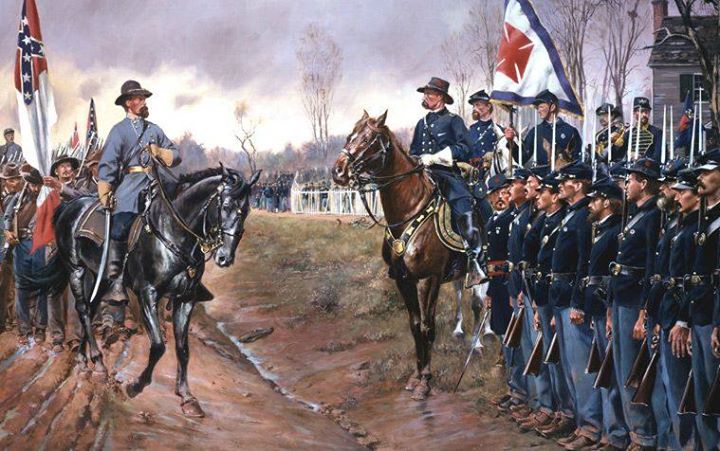
On April 9, 1865, the Civil War came to an end. It lasted four years and resulted in approximately 630,000 deaths and over 1 million casualties. General Robert E. Lee surrendered the Confederate Army of Northern Virginia to Lieutenant General Ulysses S. Grant, at the home of Wilmer and Virginia McLean in the rural town of Appomattox Court House, Virginia. General Lee arrived at the McLean home shortly after 1:00 p.m. followed a half hour later by General Grant. The meeting lasted approximately an hour and a half. Sixteen individuals are known to have attended at least part of the meeting. This is evident in Keith Rocco’s painting (shown right). Each army bore its respective banner.
National Park Service
Biblical Application
The definition is found in Exodus 3:13-14. Verse 14, “And God said to Moses, “I AM WHO I AM,”[a] and He said, “You will say this to the children of Israel, ‘I AM has sent me to you.’ ”
Throughout the years after his flight from Egypt, Moses served as a shepherd over the flock of Jethro his father-in-law. An angel appeared to Moses in a burning bush that was not consumed, drawing his interest. Read Exodus 3 for the full story. God declared, “…I have come down to deliver them out of the hand of the Egyptians, and to bring them up out of that land to a good and spacious land, to a land flowing with milk and honey, to the place of the Canaanites, the Hittites, the Amorites, the Perizzites, the Hivites, and the Jebusites.”
God’s Promise
In Exodus 6:6, God reveals how He would lead the children of Israel out of Egypt, out of bondage.
An army’s banner signals the authority under which the army goes to battle. After the defeat of the Egyptian enemy, “Then Moses built an altar and called the name of it, The Lord Is My Banner [Exodus 17:15].”
Moses confirmed that it was Jehovah-Nissi who delivered the children of Israel from the Egyptian enemy.
Personal Application
Daily, our lives are under attack. Satan comes against us to steal, kill, and destroy us [John 10:10]. Spiritual warfare will not end until the Lord has put all enemies under His feet [1 Corinthians 15:25].
Jesus gave us His format for prayer in Matthew 6:5-15. Most Bibles show these scriptures as “The Lord’s Prayer.” It’s not the Lord’s prayer; it’s our model for effective prayer. Jesus instructs us, “Therefore pray in this manner.”
The first step of the model prayer is to hallow the name of God. We sanctify, honor as holy, and consecrate the name of our Heavenly Father.
What is His name? He has many. Dr. Larry Lea, in his book Could You Not Tarry One Hour?, outlines eight names of God and the associated benefits of sanctifying these names.
| Benefit | Name | Meaning |
Sin | Jehovah-tsidkenu | The Lord My Righteousness |
| Jehovah-m’kaddesh | The Lord Who Sanctifies | |
| Spirit | Jehovah-shalom | The Lord Is Peace |
| Jehovah-shammah | The Lord Is There | |
| Soundness | Jehovah-rophe | The Lord Who Heals |
| Jehovah-jireh | The Lord’s Provision Shall Be Seen | |
| Security | Jehovah-nissi | The Lord My Banner |
| Jehovah-rohi | The Lord My Shepherd |
Summary
You will not be the source of your deliverance. God is the source of your deliverance. Philippians 4:13 says, “I can do all things because of Christ who strengthens me.”
If you rely solely on your own strength, you will be alone. Using only your intellect to get out of an evil or undesirable situation means you are on your own.
Choose to rely on the Creator of the universe, the Almighty God to be the banner over your situation.
1 Corinthians 15:57, “But thanks be to God, who gives us the victory through our Lord Jesus Christ!”
John White
Rockwall, Texas
 John N. White