
Climate alarmists view “the climate” as a monolithic atmosphere typical throughout the Earth, irrespective of geographical locales.
How many climates are there? Many. You can experience radically different climates around the country and around the world, if you are up to some travelling.
- The climate of the Arctic
- The climate of the Antarctic
- The climate of Hawaii
- The tropical climate of Manaus, Brazil
- The two climates of Western Australia
- The climates of California: Mountain climate, Pacific coastal climate, desert climate of Southeastern California, etc., etc.
Want to surf the Pacific Ocean or go snowboarding in California? You can do both on the same day!
Over my lifetime, climate alarmists first foretold (falsely prophesied) global cooling. Later, and until recently, they prophesied global warming. Their current mantra is climate change. Between global cooling and global warming, they hammered us with their claims that our hairspray and refrigerants were causing the ozone hole (O3) over Antarctica.
The Ozone Hole
NASA scientists reported the actual cause of the Ozone Hole on October 4, 2004, in an article titled Nasa Ozone Watch: Ozone hole facts. This article was taken down from the website, but the wonderful internet can’t be edited; only the text of articles to which the internet points can be taken down by their originators; the titles remain online.
NASA and the USGS have been converted from researching and reporting genuine science. These two formerly scientific services are now departments of the U.S. Ministry of Propaganda. (I made up this name, but it’s a real entity located in Washington, D.C.)
Where is my proof?
The December 2015 ScienceDirect study titled, The Antarctic ozone depletion caused by Erebus volcano gas emissions, reported on the kilotons of hydrogen chloride (HCl) and sulfur dioxide (SO2) gasses emitted at varying rates by the active volcano Mount Erebus. Kilotons are thousands of tons. These two gasses readily neutralize ozone.
Why would genuinely honest scientists publish such a report? Because it is the truth and they are not employees of the U.S. government.
On September 3, 2008, the magazine New Scientist reported ‘Chemical equator’ protects Antarctica’s clean air. Days later, on September 30, 2008, LiveScience reported Earth’s Air Divided by Chemical Equator.
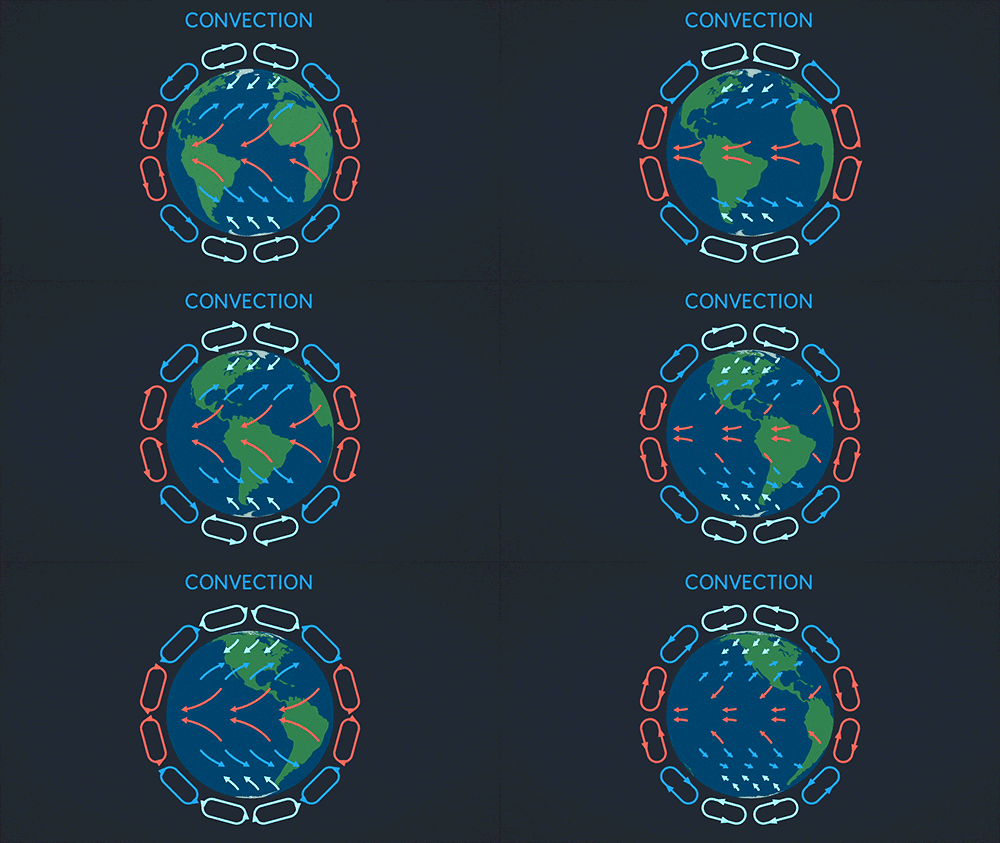
The Chemical Equator is not a new phenomenon. Scientists created this name in 2008 after discovering industrial gasses do not cross the ITCZ. Ancient mariners called this zone The Doldrums. The modern name for this moveable zone is the Intertropical Convergence Zone, ITCZ. What is the wind direction in the center of the ITCZ? Up. Sailing ships are left still in the water which is why the mariners of old gave the name The Doldrums.
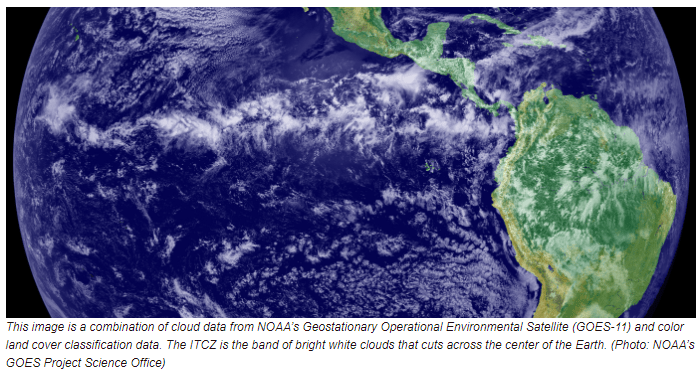
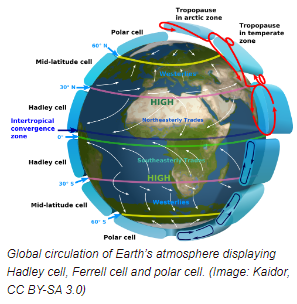
An MIT-NASA study published by MIT titled The Sticky Intertropical Convergence Zone was published on July 25, 2017.
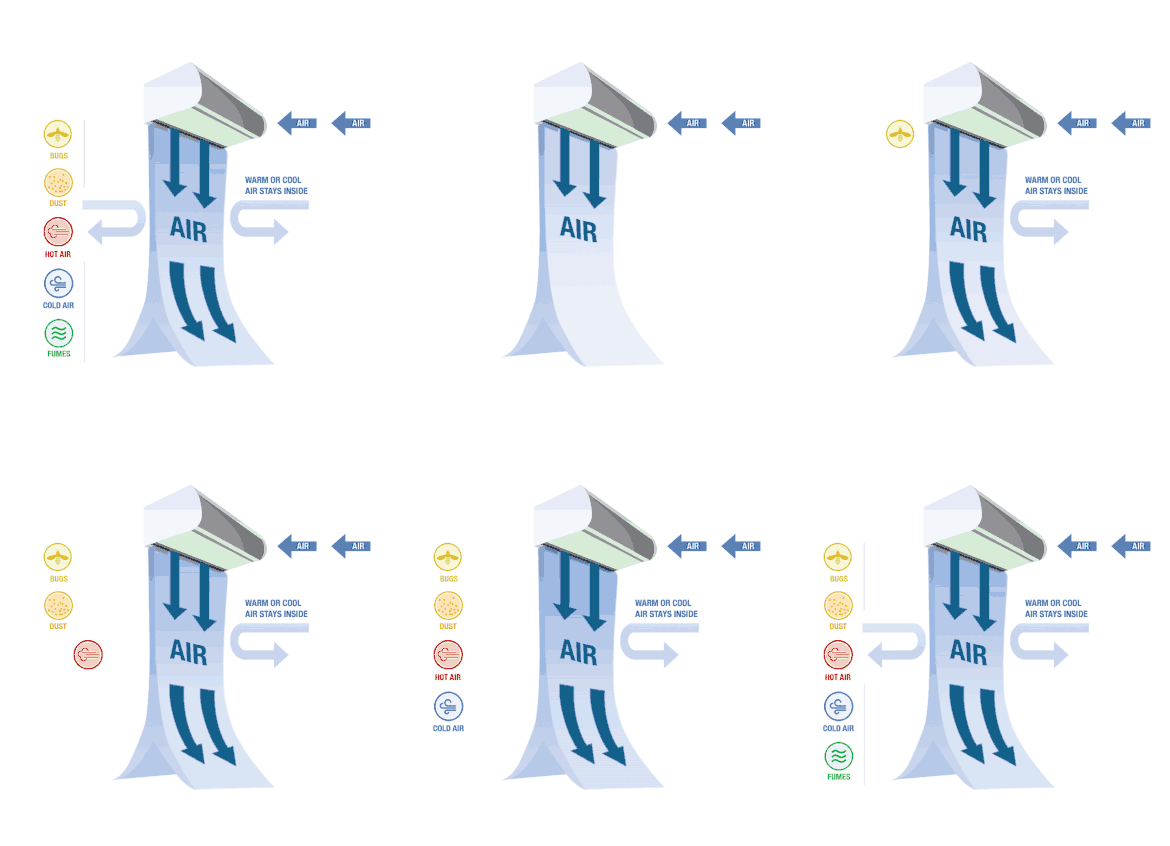
The ITCZ performs as a natural air curtain to isolate the gasses of the Northern and Southern Hemispheres.
What is an air curtain?
“An air curtain, also known as an air door, is a machine that blows a controlled stream of air across an opening to the other side to create an air seal. This seal separates different environments while allowing a smooth, uninterrupted flow of traffic and unobstructed vision through the opening. Because they help to contain heated or conditioned air, they provide sizable energy savings and increased personal comfort when applied in industrial or commercial settings. They also help to stop the infiltration of pollutants and flying insects.” Berner Air Curtains 101
Natural Systems Preserve the Earth
The Thermal Cycle
MIT News, November 16, 2022, Earth can regulate its own temperature over millennia, new study finds
Quote: “The Earth’s climate has undergone some big changes, from global volcanism to planet-cooling ice ages and dramatic shifts in solar radiation. And yet life, for the last 3.7 billion years, has kept on beating.
“Now, a study by MIT researchers in Science Advances confirms that the planet harbors a “stabilizing feedback” mechanism that acts over hundreds of thousands of years to pull the climate back from the brink, keeping global temperatures within a steady, habitable range.
“Just how does it accomplish this? A likely mechanism is “silicate weathering” — a geological process by which the slow and steady weathering of silicate rocks involves chemical reactions that ultimately draw carbon dioxide out of the atmosphere and into ocean sediments, trapping the gas in rocks.
“Scientists have long suspected that silicate weathering plays a major role in regulating the Earth’s carbon cycle. The mechanism of silicate weathering could provide a geologically constant force in keeping carbon dioxide — and global temperatures — in check. But there’s never been direct evidence for the continual operation of such a feedback, until now.” Unquote
The Carbon Cycle
I emphasize the foundation for all life on Earth.
Quote: “Carbon is the foundation of all life on Earth, required to form complex molecules like proteins and DNA. This element is also found in our atmosphere in the form of carbon dioxide (CO2). Carbon helps to regulate the Earth’s temperature, makes all life possible, is a key ingredient in the food that sustains us, and provides a major source of the energy to fuel our global economy.
“The carbon cycle describes the process in which carbon atoms continually travel from the atmosphere to the Earth and then back into the atmosphere. Since our planet and its atmosphere form a closed environment, the amount of carbon in this system does not change. Where the carbon is located — in the atmosphere or on Earth — is constantly in flux.” Unquote
The Water Cycle
Quote: “The water cycle describes how water is exchanged (cycled) through Earth’s land, ocean, and atmosphere. Water always exists in all three phases, and in many forms—as lakes and rivers, glaciers and ice sheets, oceans and seas, underground aquifers, and vapor in the air and clouds.” Unquote
The Solar Cycle
Union of Concerned Scientists, July 16, 2009: How Does the Sun Affect Our Climate?
Quote: “The Sun is the source of most of the energy that drives the biological and physical processes in the world around us—in oceans and on land it fuels plant growth that forms the base of the food chain, and in the atmosphere it warms air which drives our weather.
“The rate of energy coming from the Sun changes slightly day to day. Over many millennia the Earth-Sun orbital relationship can change the geographical distribution of the sun’s energy over the Earth’s surface. It has been suggested that changes in solar output might affect our climate—both directly, by changing the rate of solar heating of the Earth and atmosphere, and indirectly, by changing cloud forming processes.” Unquote
The Tidal Cycles
You “land lubbers” have no appreciation of the tidal effects on your daily life. We who have lived along the coastal areas of the oceans and the Gulf of Mexico know them very well.
There are two high tides and two low tides each lunar day.
The following video describes the tidal periods.
For those who appreciate math and science, Newton’s Law of Gravity. The following video has you wading a little deeper into the field of physics, but even if you are not a math whiz, the demonstrations will prepare you for some not-so-obvious effects happening around you and in you at every moment of the day.
Let’s wade into a little deeper ‘water.’ It is our nature to assume a flat-earth mindset. But nature and nature’s God, have created a marvelous and wonderous universe.
To this point, you are more aware of the variability of tidal forces. Or are you?
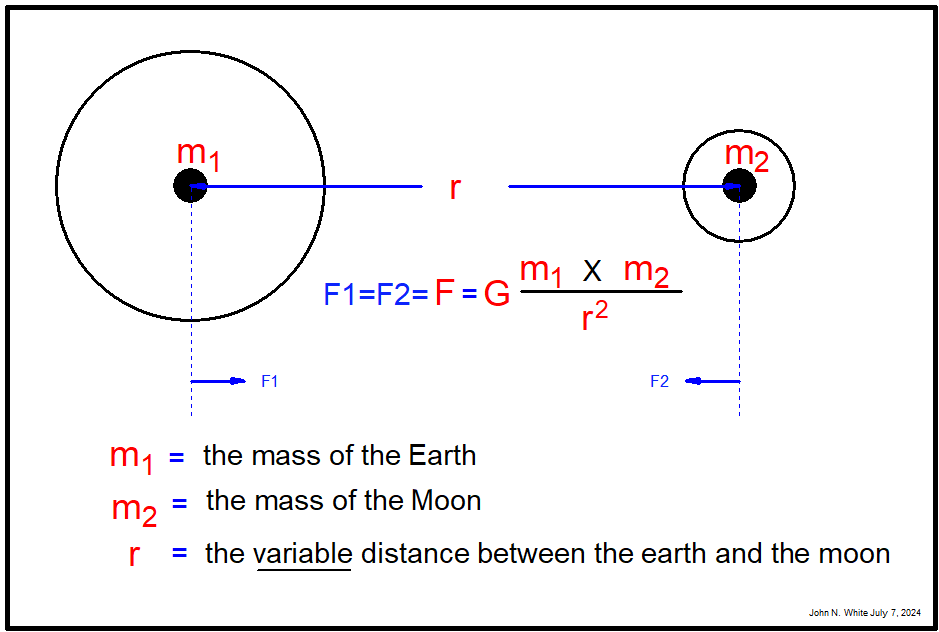
The distance between the Earth and the Moon continuously changes because the orbit of the Moon is elliptical.
- The average distance between the Earth and the Moon is 384.400 km (238,606.5 statute miles)
- At perigee, the point nearest the Earth, the distance is 362.1024 km (225,623 statute miles)
- At apogee, the point farthest from the Earth, the distance is 405.5547 km (252,655 statute miles)
Learn the next perigee and the next apogee from TimeAndDate.com.
A natural phenomenon called tidal locking maintains the same side of the Moon always facing Earth.
Terrestrial Tides
“The moon exerts a tidal force on the whole planet. This has little effect on Earth’s land surfaces, because they are less flexible. Land surfaces do move, however, up to 55 centimeters (22 inches) a day. These movements are called terrestrial tides. Terrestrial tides can change an object’s precise location. Terrestrial tides are important for radio astronomy and calculating coordinates on a global positioning system (GPS). Volcanologists study terrestrial tides because this movement in the Earth’s crust can sometimes trigger a volcanic eruption.” National Geographic, Cause and Effect: Tides
Human Cycles Affected by The Moon
Quote: “As the average length of women’s menstrual cycles matches the moon’s 29.5-day waxing and waning cycle, many cultures associated the moon with fertility. The celestial body’s influence on humans biology had largely been dismissed as myth, but several recent studies have linked lunar phases with sleep and moods. In a study published on January 27 in Science Advances, researchers analyzed long-term data from women and found that for some their periods synced with lunar light and gravity cycles at certain times in their lives.
“[The study] has not completely settled the debate,” says Kristin Tessmar-Raible, a chronobiologist at the University of Vienna who was not involved with the research. “But it’s really cool that this puts fresh spirit into the whole discussion: is the moon—yes or no—[affecting] human biology.” Unquote
Read more from TheScientist, February 5, 2021, Menstrual Cycles Intermittently Sync with Moon Cycles: Study
From the NIH, the National Library of Medicine, Moonstruck sleep: Synchronization of human sleep with the moon cycle under field conditions
Quote: “Before the availability of artificial light, moonlight was the only source of light sufficient to stimulate nighttime activity; still, evidence for the modulation of sleep timing by lunar phases is controversial. Here, we use wrist actimetry to show a clear synchronization of nocturnal sleep timing with the lunar cycle in participants living in environments that range from a rural setting with and without access to electricity in indigenous Toba/Qom communities in Argentina to a highly urbanized postindustrial setting in the United States. Our results show that sleep starts later and is shorter on the nights before the full moon when moonlight is available during the hours following dusk. Our data suggest that moonlight likely stimulated nocturnal activity and inhibited sleep in preindustrial communities and that access to artificial light may emulate the ancestral effect of early-night moonlight.” Unquote
The El Nino Southern Oscillation (ENSO)
Climate alarmists labor hard to convince us that the El Niño-Southern Oscillation is the product of human activity. The ENSO is a product of the Nazca Plate colliding with the South American Plate. Plate movements are not constant.
The ENSO is marked by two things in Peru. First, warm coastal waters and poor fishing. Warm coastal waters make for terrible fishing, and the Peruvian people depend on seafood.
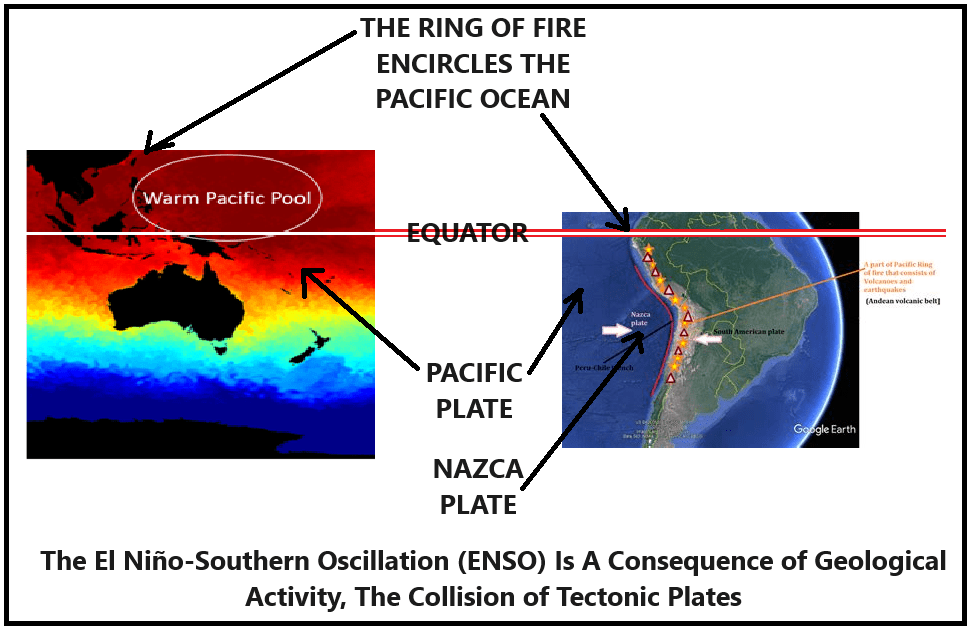
Learn about the Ring of Fire from the World Atlas.
Quote: “The Pacific Ring of Fire is known variously as Ring of Fire, Circum-Pacific Belt, or Girdle of Fire. It is an underwater region on the edges of the Pacific Ocean where numerous earthquakes and volcanic eruptions take place. The majority of the world’s earthquakes and volcanic activities take place around the Ring of Fire. It is a U-shaped belt of approximately 40,250 kilometers long and 500 kilometers wide, with a chain of over 450 volcanoes. The volcanic activities occur when the Pacific plate collides or slides into other tectonic plates around it. The tectonic plate sliding in some areas around the Ring of Fire has also led to the formation of deep underwater trenches, like the Mariana Trench, the world’s deepest spot.”
The atmosphere does not heat the land. The land heats the atmosphere. Ocean waters heated by volcanic activity also heat the air.
Learn more about heatwaves across the United States from AGU Geophysical Research Letters: Longer- and Slower-Moving Contiguous Heatwaves Linked to El Niño
Quote: “Although it is known that the frequency and intensity of heatwaves are affected by the El Niño–Southern Oscillation (ENSO), unknown are the ENSO modulations on the moving properties (e.g., moving distance and speed) of spatiotemporally contiguous heatwaves. Here, we investigate the relationship between ENSO and the moving patterns of contiguous heatwaves. We show that contiguous heatwaves are likely more frequent, more persistent, and longer-traveling, but slower-moving during El Niño than La Niña episodes. The differences in the tropical contiguous heatwaves between El Niño and La Niña are influenced by persistent high-pressure anomalies. During the following summers, El Niño can induce anomalous atmospheric circulation characterized by an intensified subsidence over the western North Pacific and ascending motion over the tropical Indian and Pacific Oceans. These features provide favorable conditions for the occurrence and maintenance of contiguous heatwaves.” Unquote
John White
Rockwall, Texas


