
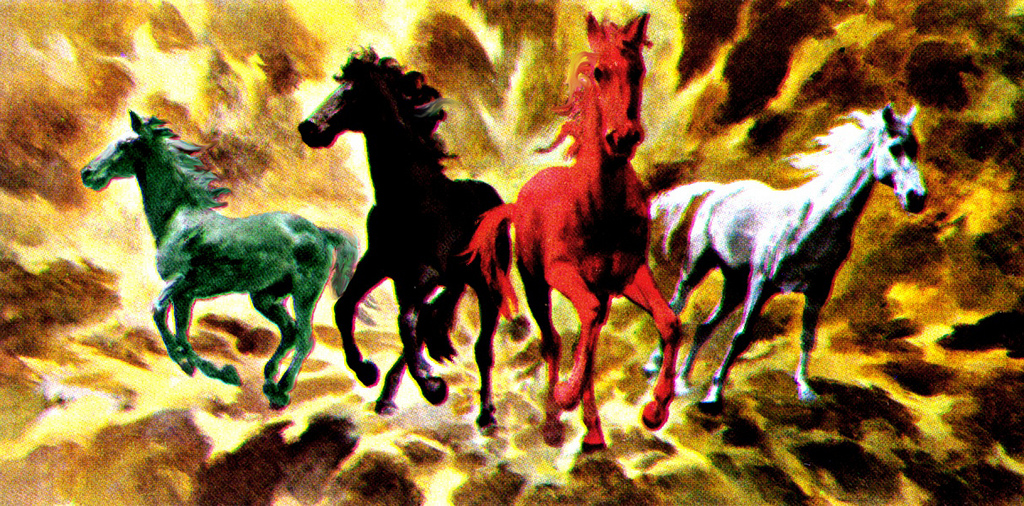
1 I saw when the Lamb opened one of the seals. Then I heard one of the four living creatures saying, with voice like thunder, “Come and see.” 2 And I looked, and there before me was a white horse. He who sat on it had a bow. And a crown was given to him, and he went forth conquering that he might overcome.
3 When He opened the second seal, I heard the second living creature say, “Come and see.” 4 Then another horse that was red went forth. Power was given to him who sat on it to take peace from the earth, causing people to kill one another. Then a great sword was given to him.
5 When He opened the third seal, I heard the third living creature say, “Come!” I looked, and there was a black horse, and he who sat on it had a pair of scales in his hand. 6 Then I heard a voice in the midst of the four living creatures saying, “A quart of wheat for a day’s wages, and three quarts of barley for a day’s wages, and do not harm the oil and the wine.”
7 When He opened the fourth seal, I heard the voice of the fourth living creature say, “Come!” 8 So I looked, and there was a pale [G. 5515, green] horse, and the name of him who sat on it was Death, and Hades followed him. Power over a fourth of the earth was given to them, to kill with sword, with hunger, with death, and by the beasts of the earth.
Revelation 6:1-8 MEV
What do the colors of the horses represent?
Learn from Christian.net, What Color Are The Four Horses In The Book Of Revelation
White: “The color white holds profound significance in biblical symbolism, often representing purity, victory, and triumph. In the context of the white horse and its rider, the imagery evokes a sense of authority and conquest, signifying the powerful forces at play during the apocalyptic events foretold in the Book of Revelation. The rider’s possession of a bow further emphasizes the theme of conquest and the wielding of authority, suggesting a potent and decisive force unleashed upon the world.”
Red: “The color red holds potent symbolism in biblical imagery, often signifying blood, warfare, and upheaval. In the context of the red horse and its rider, the imagery evokes a sense of turmoil and discord, foreshadowing the tumultuous events that will unfold during the apocalyptic period. The rider’s authority to take peace from the earth and to incite conflict underscores the profound impact of his actions, signaling a time of unprecedented upheaval and strife.”
Black: “The color black holds potent symbolism in biblical imagery, often representing darkness, mourning, and the consequences of moral transgression. In the context of the black horse and its rider, the imagery conveys a sense of scarcity and economic disparity, signaling a period of hardship and ethical reckoning. The rider’s possession of scales underscores the theme of economic imbalance and the ethical dimensions of societal conduct, highlighting the profound implications of human actions within the divine framework of judgment and justice.”
Pale [green]: “The color pale holds potent symbolism in biblical imagery, often representing sickness, decay, and the transitory nature of human existence. In the context of the pale horse and its rider, the imagery conveys a sense of mortality and the devastating consequences of pestilence and death. The rider’s authority over a fourth of the earth to bring about death through various means underscores the profound impact of mortality and the far-reaching implications of human frailty within the divine framework of judgment and mortality.”
Are these colors significant today?

The flags of the nine Muslim countries and the Palestinian territories are remarkably similar in colors and patterns. They are undoubtedly significant to the people who created them. What is the significance of the four colors common to all ten flags? The salient point is that these flags represent unfriendly countries toward Israel. Perhaps ‘unfriendly’ is too kind a word. We should focus on the colors of the four horsemen and their steeds.
Matthew 24 — A peek into our future
Read Matthew 24:1-51. After you have read this chapter, I ask, “How has the text in those 51 verses affected your long-range plans?”
Do the scriptures from Revelation 6 and Matthew 24 test your personal sense of worth? Do you believe Jesus’ warnings 2,000 years ago connect with your sense of truth?
That last question precipitates another. What is truth to you?
What is my point of view?
- Genuine science confirms the Word of God in every aspect.
- Truth is not relative to any human circumstance or opinion. Truth is the way things really are. God is our Creator, the Grand Omnipotent Designer of the Universe and all within it. Jesus is the way, the truth, and the life.
- Jesus is the only begotten Son of God. We believers in Jesus are God’s adopted sons and daughters.
- As it is written, “For we walk by faith, not by sight.“
- God forewarns mankind of the consequences of sinning against Him. He also forewarns all of mankind of the consequences of cursing, abusing, threatening, or attacking Israel, a people whom he has chosen to communicate His will to the world at large.
Action
Have a Biblical understanding of faith. The Hebrew word for faith, Tik-Va [תִּקְוָה] translates to English hope, but is not wishful thinking; it’s waiting with expectation.
Have a clear understanding of blessings and cursing. These two English words are not self-explanatory. Let’s use the Spanish language to clarify your understanding. The Spanish verb bendecir breaks down to “good to say,” and the Spanish verb maldecir means “bad to say.” Blessings and cursing are things you say. We learn from James 3:10, “Out of the same mouth proceed blessing and cursing. My brothers, these things ought not to be so.“
Pray for Israel and the Jews, those abroad, and those nearby in your community. Specifically, bless the Jews, as directed by Numbers 24:9. He [Israel] crouches, he lies down as a lion, and as a lion, who will stir him up? “Blessed is he who blesses you, and cursed is he who curses you.”
Finally, Pray for the peace of Jerusalem: “May they prosper who love you! Psalm 122:6
John White
Rockwall, Texas

 John N. White