
Introduction
Mark, the shortest of all New Testament gospels, is likely the first written, yet it often tells of Jesus’ ministry in more detail than either Matthew or Luke, for example, the miracle stories. It recounts what Jesus did in a vivid style, where one incident follows directly upon another. In this almost breathless narrative, Mark stresses Jesus’ message about the Kingdom of God. Mark, the shortest text of the four Gospels, mentions the Kingdom of God 15 times. Mark’s mentions of the Kingdom of God compare to the Gospels of John, 2 times, of Matthew, only 5 times, and Luke, 33 times.Ref
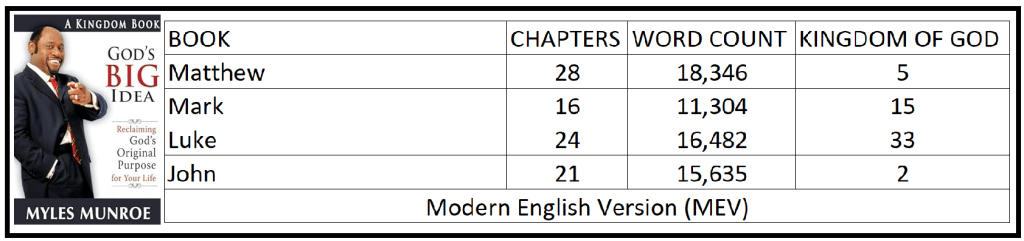
Bible teacher Myles Munroe’s book GOD’S BIG IDEA: Reclaiming God’s Original Purpose for Your Life, available from Amazon, emphasizes how the ideas of men govern the world. The ideas of the founders of governments live on long after the deaths of the founders.
Myles points to God’s big idea, the Kingdom of God. Since God cannot die, His ‘big idea’ lives forever. The books of Mark and Luke point us to God’s big idea.
Pentecost | Shavuot
As recorded in Acts 2:10, the people present on that day of Pentecost included Jews and Jewish proselytes from Cyrene and Rome.
Pentecost is a central feast of Judaism. Known as the Feast of Weeks (Exodus 34:22), or Shavuot in Hebrew, it is, together with Pesach and Sukkot, one of the three pilgrimage feasts of Israel during which each adult male was required to be present in Jerusalem (Ex 23:14-17, 1446 BC). Ref
Shavuot, the Jewish Pentecost, is a holiday that today commemorates the single most important event in Israel’s history: the giving of the Torah (the first five books in the Hebrew Bible) to Moses at Mount Sinai…Although it is not as well-known among non-Jews as Passover or Sukkot, the Feast of Booths, it is one of the three major festivals often called “pilgrim” festivals because in Bible times, all Jewish males were required to observe them at the Holy Temple in Jerusalem…Shavuot occurs 50 days after the first day of Passover, it was referred to as Pentecost [Greek fiftieth] in the Christian Bible…The holiday is also known as the “Feast of Weeks,” since it is celebrated seven weeks (or 50 days) after Passover. Ref
What exactly were Jesus’ followers observing during Shavuot, the Jewish Pentecost? During the days of the First and Second Temples, Shavuot was a harvest festival. Called the “Festival of Harvest” (Exodus 23:16, 1446 BC), sheaves of barley (the winter crop) were brought to the Temple each day, beginning on Passover until Shavuot, the beginning of the harvest season 50 days later. It was a joyous celebration, with the people bringing the firstfruits of their harvest to the Temple with thanksgiving to God for His provision. Ref
Cyrenians
At Cyrene, also, on the north coast of Africa, lying between Egypt and Carthage, there was a large Jewish population. Strabo, quoted by Josephus, describes them as a fourth of the whole (Jos. Ant. xiv. 7, § 2). They were conspicuous for the offerings they sent to the Temple, and had appealed to Augustus for protection against the irregular taxes by which the provincial governors sought to intercept their gifts (Jos. Ant. xvi. 6, § 5). In Simon of Cyrene, we have had a conspicuous member, probably a conspicuous convert, of this community. (See Note on Matthew 27:32.) Later on, clearly as the result of Stephen’s teaching, they are prominent in preaching the gospel to the Gentiles of Antioch. We may think of Simon himself, and his two sons Alexander and Rufus (Mark 15:21, (30 AD), as probably members of this society.
Bible Hub, Ellicott’s Commentary for English Readers: Cyrenians.

Marked as Christians
Before and after the Day of Pentecost (Shavuot), the followers of Jesus were recognized as Jews who had become ‘followers of the Way.’ Six verses: Acts 9:1-2 [34 AD], Acts 19:9 [54 AD], Acts 19:23 [54 AD], Acts 22:4 [59 AD], Acts 24:14 [60 AD], and Acts 24:22 [60 AD].
The followers of the Way were first called Christians in Antioch (Acts 11:25-30, 37 AD).
Jesus said to [Thomas], “I am the way, the truth, and the life. No one comes to the Father except through Me.“
Following Cyrenians to Rome
Cyrene was founded in 631 B.C. by Greek migrants who fled from famine and went south to what is now known as Libya. At the time, Libya was the name given to all of North Africa. Berbers already lived in the area, and they welcomed the Greeks. By 85 B.C., Cyrene was home to Greeks, Berbers, Jews, and other foreigners. The Berbers and Greeks built five cities that came to be called the Pentapolis, with Cyrene being the most important city — a city of philosophers and poets and a mix of Greek and Berber culture.
According to Youcef’s research, Simon, Rufus and Alexander returned to Cyrene, and they visited synagogues to share that they met the Messiah. The word “Libya” means helper, and Simon, without knowing, ultimately went to Jerusalem to help Jesus.
Later, a group of believers began to preach the Gospel in Cyrene, and believers spread the Good News to Carthage, Tunisia and Alexandria, Egypt, key cities in the rise of Christianity.
In 33 A.D. Simon and his sons, Rufus and Alexander, made the pilgrimage from Cyrene to Jerusalem to celebrate Passover. Simon happened to be walking down the street at the same time soldiers were leading Jesus to His death. He was singled out and forced to carry Jesus’ cross to Golgotha.
Excerpt, Baptist Press: Christianity’s long history in North Africa, September 25, 2023
What was the age of Rufus at the time of the epistle of Romans? The ages of Alexander and Rufus were not stated in the scripture, but whatever the age of Rufus at the time of the crucifixion of Jesus Christ, he was 27 years older at the time of the letter to the Roman church. I assume all the greetings of Paul were to prominent leaders in the Roman church.
Circa 57 AD, Paul, in Corinth at the writing of Romans, wrote to the Christians in Rome. He expressed his greetings to several prominent church leaders, including Rufus and his mother. Paul wrote, “Greet Rufus, chosen in the Lord, and his mother, who is like a mother to me.”
My Assumptions and Conclusions
Jewish Christians in Libya migrated to Rome. Jews were moved about the world by changes in material needs or persecution. There, in the Roman body of Christians, Rufus and Alexander, along with their mother, became leaders. I assume the absence of mention by Paul of Alexander was due to Alexander’s probable earlier death. Why do I assume Alexander had been in a leadership position? Mark’s mention of Simon and his two sons, Rufus and Alexander, indicates the two boys became significant among the believers in Rome.
The Apostle Mark was born in Cyrene. He traveled with Saint Barnabas and Saint Paul on many religious missions, during which he founded the Church of Alexandria.Ref Mark died circa April 25, 68 A.D., in Alexandria, Egypt. Ref
The Gospel of Mark was likely one of the first books written in the New Testament, probably in A.D. 55-59. Ref Mark’s mention of the names of Rufus and Alexander in Mark 15:21 strongly suggests Mark knew Simon, a fellow Cyrenian.
It is generally agreed that Mark is the John Mark of the New Testament (Acts 12:12). His mother was a wealthy and prominent Christian in the Jerusalem church, and probably the church met in her home. Mark joined Paul and Barnabas on their first missionary journey, but not on the second because of a strong disagreement between the two men (Acts 15:37-38). However, near the end of Paul’s life he called for Mark to be with him (2 Timothy 4:11).
Got Questions?—Summary of the Gospel of Mark
J. Warner Wallace, writing in Cold-Case Christianity, speculates the Apostle Peter was the source of most of Mark’s information, “Peter [aka Simon] is the first disciple identified in the text (Mark 1:16), and the last disciple mentioned in the text (Mark 16:7).”
Knowledge is Power
John White
Rockwall, Texas

 John N. White