
The Goal of this Article
José Martí (1853-1895) was a Cuban nationalist credited with Cuba’s liberation from Spain. He was not involved in the communist takeover of Cuba in 1959. Learn about this amazing man from Britannica.
I cherish the wisdom of José Martí. He said, “El primer deber de un hombre es pensar por sí mismo.” Translation: “The first duty of a man is to think for himself.”
All too many mindless Americans readily give in to subversive and unwholesome creeds. These creeds are generally aligned with leftist regressive blind leaders. These leaders privately and secretly fund our citizens to foment riots. They also encourage them to be combative with law enforcement officials. Some of the un-American, unscientific initiatives are anthropogenic global warming and climate change.
The following facts and comments are intended to provoke Americans to think for themselves.
Viewpoint on Science
The aim of this post is to give the reader food for thought. Not all things described as science are truly scientific. Too many scientific research projects get funding from self-serving people or leftist organizations. Their highest priority is to ascribe undesirable phenomena to human activity.
Science is not groupthink. Science is a method of testing hypotheses. It is used to derive the root causes of undesirable outcomes from diseases, geological events, weather, and more.
The scientific method is not a consensus of innumerable persons. The scientific method is an unbiased process.
A true scientist tests, that is to say, attempts to defeat a hypothesis. Read: Science Without Skepticism Is Just Politics in a Lab Coat. The word test comes from Latin

Image credit: Examples of: 7 Steps of the Scientific Method Examples Explained Clearly
Genuine scientists follow the steps depicted above, then submit the findings for peer review. Critiques from peer review then motivate the scientist to publish findings. Alternatively, they repeat the scientific method to more accurately reach verifiable findings. How many scientists review a conclusion? One to many. If the findings are submitted to a known expert on a particular topic, one expert’s review may verify the findings.
Personal Life Experience
My entire life’s work has basically been instruments and control systems (I&C), from aircraft systems to large military installations. Depending on the specific application, much of my work has been energy-saving performance contracting (ESPC).
Another major sector has been indoor air quality (IAQ) for hospitals and biological laboratories. It also serves operating rooms, infectious isolation spaces, and clean rooms.
The most common measurements in my projects have been temperature, relative humidity, and dew point. I also measure pressure and flow rates of gases and liquids. Additionally, I track electrical properties like amperes, volts, and Watts.
Consider some news stories.
- BBC, 1/13/2026:Global temperatures dipped in 2025 but more heat records on way, scientists warn
- Earth.com, 12/24/2025: Year in Review: The Biggest Climate Headlines of 2025
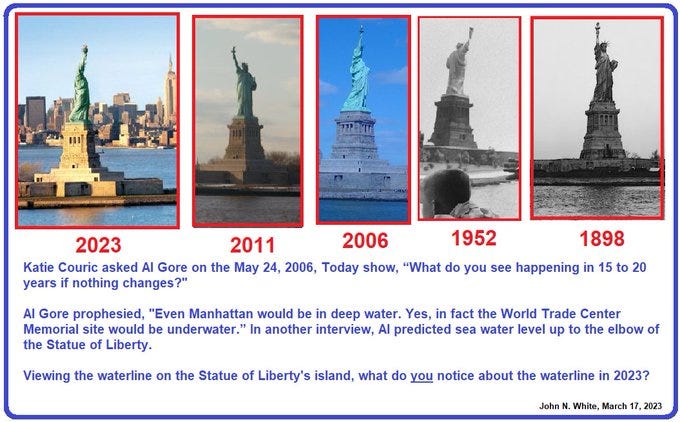
- Vanity Fair, 1/20/2027: Al Gore Takes No Pleasure in Being Right About Environmental Catastrophe (I include this story to underscore the hypocrisy of many scientists.)
- Doctors for Disaster Preparedness, 10/2/2017: Climate Change IQ Question 4: Will Manhattan and Florida soon be underwater if humans do not curtail [the] use of “fossil fuels”?
- CO2 Coalition, 1/16/2026: Rejecting Climatism: Trump Withdraws from UNFCCC and 66 International Organizations
The trump order also withdraws the U.S. from the Intergovernmental Panel on Climate Change (IPCC). The IPCC has been the U.N. body responsible for “assessing the science related to climate change.” The IPCC issued six assessment reports from 1990 to 2023, each asserting that humans were responsible for global warming. With the withdrawal, the U.S. will no longer participate in the IPCC or fund IPCC efforts.
Climate alarmists say “the earth” as though it were a celestial orb with a uniform climate
Let’s pause for a geography break.
Earth’s Geographical Facts
- The other is not a sphere but an oblate spheroid.
- What is the most distant point on Earth from the center of the Earth? (Hint: It’s not Mount Everest.) In the future, this will change. Mount Everest is ever rising, based on altitude measurements in 1954 and 2020.
- The summit of Mount Chimborazo in Ecuador is the point on Earth that is the farthest from the Earth’s center. This information is provided by NOAA. The name of the country, Ecuador, translates to equator.
- It is the spinning of the Earth about its axis that causes the equatorial bulge at the equator.
- Total surface area of the Earth: 196,900,000 square miles
- Land mass is approximately ~29% of the total surface area: 57,101,000 square miles
- Surface water covers approximately ~139,799,000 square miles
- The Northern Hemisphere features ~68% of the land mass
- The Southern Hemisphere features 32% of the land mass
Atmospheric Circulation Facts
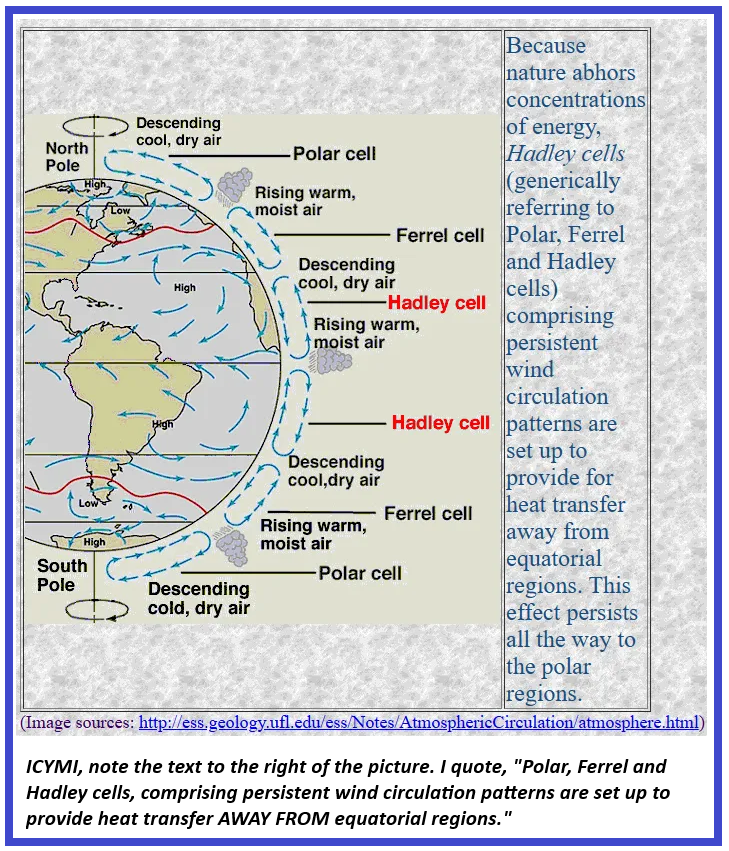
- The Intertropical Convergence Zone (ITCZ) separates the northern hemisphere from the southern hemisphere. Ancient mariners knew this area as “the doldrums.” The interaction between the northern and southern Hadley cells (see diagram below) forms a two-sided upward air curtain. Where can you experience an air curtain? Large warehouse stores (Sam’s, Costco) feature horizontal air curtains at the entrances to the dairy storage room. Image credit: University of Oregon: Physics and Energy & Environment—Lecture 14
- What is the wind direction between the two Hadley cells? Wind direction is upward.
- In 2008, “Scientists from Britain’s University of York have discovered what they’re calling a ‘Chemical Equator’ that separates the Southern and Northern Hemispheres. This band, which lies in the Western Pacific, is estimated to be 50 km wide and acts as a divider, keeping the pollutants of the northern hemisphere from contaminating that of the hemisphere below.” Source: Scientific Blogging: 12/24/2008, There’s A ‘Chemical Equator’ – And We’re On The Wrong Side Of It
Although atmospheric pollution has been recorded for some time, the difference in pollution levels within each hemisphere was unexpected; and the number is vast.
A study conducted by the University’s Department of Chemistry shows the level of carbon monoxide being four times greater in the Northern Hemisphere verses the Southern. This finding, along with other conclusive evidence obtained, will be published in the Journal of Geophysical Research- Atmospheres.
The vast difference between the documented levels are predicted to be the result of the many wildfires that have taken place within the northern region.
The discovery of this ‘Chemical Equator’ will allow scientists to more accurately model movements of atmospheric pollution levels and provides a better footing for future climate predictions. This newly revealed chemical separation also influences the scientific understanding of how pollutants influence global climate; something that the Natural Environment Research Counsel is hoping to prove with their newest ACTIVE project.
Science 2.0: September 24th 2008: There’s A ‘Chemical Equator’ – And We’re On The Wrong Side Of It
Demonized Carbon Dioxide (CO2)
Now, For Today’s Weather Report From Mars
“Today, and every day, atmospheric gases are these: 95% carbon dioxide, 3% nitrogen, 1.6% argon, and it has traces of oxygen, carbon monoxide, water, methane, and other gases.”
“On Mars’ surface, we can find summer trends: 20 °C, the breeze of trade winds… But starting with the onset of night, temperature values plummet by several tens of degrees, and freezing conditions reaching –100 °C will prevail until the morning after. In fact, Martian soil, dry and granular, can store only very little heat. Its thermal inertia is very small compared to that of the Earth and its oceans. The atmosphere being thin, temperature variations are more significant.” Erasmus+, Daily temperature variations on Mars
Question: With an atmosphere with 95% “heat-trapping” carbon dioxide, why is Mars so frigidly cold overnight? Self-appointed ‘climate scientists’ declare CO2 a “heat-trapping gas.” Currently, the CO2 concentration in the northern hemisphere is only .04% of the whole, 416 parts per million (PPM).
Food for thought: The 95% CO2 concentration in the Martian atmosphere appears to show little to no heat-trapping properties. What does this mean for us? Should we fret over the minuscule CO2 in our earthly atmosphere?
Actually, we should fret over the minuscule CO2 in Earth’s atmosphere. Why? Carbon dioxide is the fundamental supporter of all life on Earth. As the terrestrial CO2 concentration increases, food and feed crops produce ever more products. What concentration would be better for life on Earth? Look to greenhouses for an answer.
Photosynthesis utilizes CO2 in the production of sugar which degrades during respiration and helps in plant’s growth. Although atmospheric and environmental conditions like light, water, nutrition, humidity and temperature may affect the rate of CO2 utilization, the amount of CO2 in the atmosphere has a greater influence…the concentration is much lower than ambient during the day and much higher at night in sealed greenhouses…carbon dioxide level may drop to 150 to 200 parts per million during the day in a sealed greenhouse, because CO2 is utilized by plants for photosynthesis during daytime. Exposure of plants to lower levels of CO2 even for a short period can reduce rate of photosynthesis and plant growth. Generally, doubling ambient CO2 level (i.e. 700 to 800 parts per million) can make a significant and visible difference in plant yield.
Oklahoma State University Extension, September 2023: Greenhouse Carbon Dioxide Supplementation
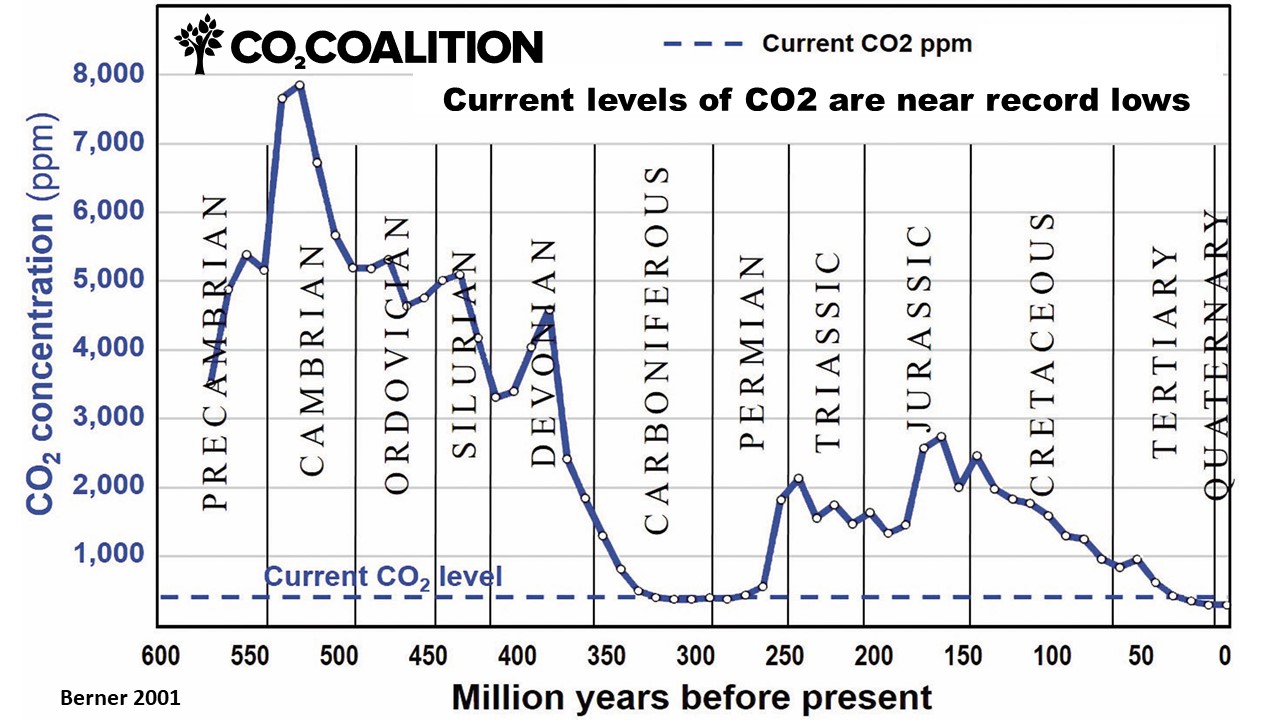
Climate alarmists predict all manner of issues with atmospheric CO2. The alarmists seem unaware of the carbon cycle process and its importance to all life on Earth. In given locales, CO2 concentration varies widely. This chart reports atmospheric concentrations of carbon dioxide over centuries of time.
What do you know about corn? Do you know that “corn thus comprises about 25% of all human food-energy production; and 3% of all total human energy production, 2x more than all wind and solar energy in 2021 combined.”1
Misanthropic climate alarmists wish to reduce the level of atmospheric carbon dioxide. Their anguish has decimated American industries and agriculture, leaving us vulnerable to attacks by our national enemies.

Dislike what deserves it, but never hate: for that is of the nature of malice; which is almost ever to persons, not things, and is one of the blackest qualities sin begets in the soul.
William Penn (1644-1718) Quaker founder of the Province of Pennsylvania
Who remembers the ‘ozone hole’?
Where was the ‘ozone hole’? Do you know?
The ozone hole got its name because of the neutralization (depletion) of ozone over the South Pole. I sarcastically refer to it as a ‘densely populated neighborhood’ (STIC).
Unscientific Nonsense
“A usual morning routine might include a spritz of hairspray, a spurt of shaving cream, or a spray of deodorant. We do these things almost automatically, not really even thinking about it. Aerosols are common, convenient, and harmless, right? It’s hard to imagine that these everyday activities could be affecting the atmosphere ten miles above Earth’s surface for the next hundred years, but in the 1970s, chemists Mario Molina and F. Sherwood Rowland discovered just that.” Berkeley University: Understanding Science—Ozone depletion: Uncovering the hidden hazard of hairspray
In the 1970s, the air conditioning system in my starter home in Garland, Texas, went kaput. In those days, Sears sold do-it-yourself products. I purchased a Westinghouse high-efficiency, precharged condensing unit (R-22 refrigerant), a precharged evaporator coil, and precharged and preinsulated refrigerant lines. The installation was 100% successful. The equipment operated for more than 30 years, long after we moved to our new home in Rockwall.
Climate alarmists persuaded Congress to require licensing of refrigerant installers and service technicians servicing refrigeration equipment. The costs of air conditioning equipment and services to homeowners and businesses skyrocketed.
A hapless old man was a one-man show demolition contractor in Florida. He was awarded a contract to remove collapsed Air Force base housing. The housing was destroyed by a hurricane. With his front-loading tractor and his dump truck, he completed the demolition. But, there was a clause in his contract. It required him to evacuate (pump down) the air conditioning equipment of freon. He also had to record the weight of the freon he removed. There was nothing to pump down. The houses were torn apart. Air conditioning systems were devoid of freon from the outset of his work. The federal government prosecuted and imprisoned the old man because he did not fill out the paperwork!
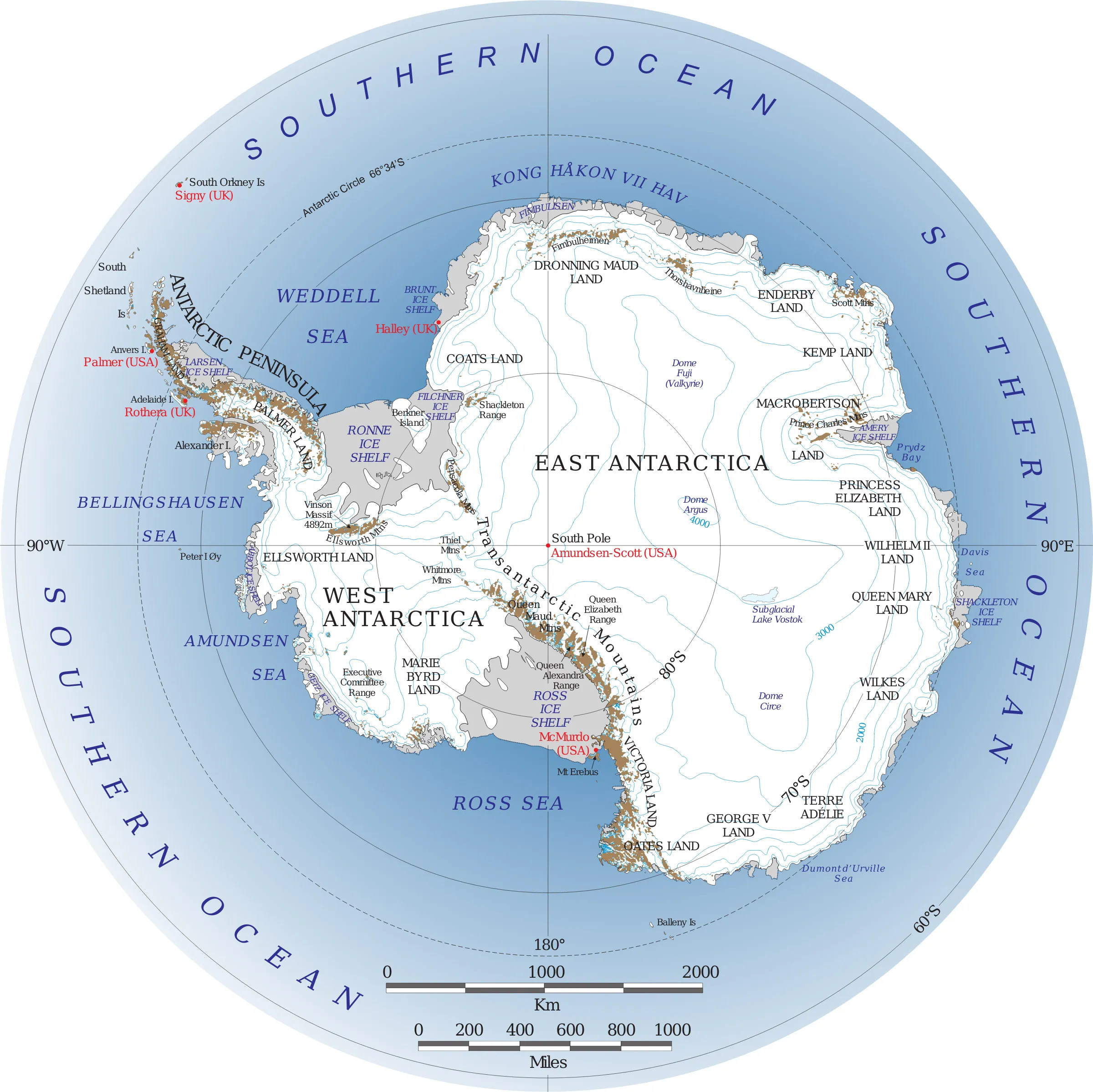
Voila! It’s a miracle! Man-made chlorofluorocarbons NEVER affected the ozone over the South Pole
Thus, for more than 40 years, Erebus volcano, which activity restarted in 1972, has been a natural source of chemical species destroying the Antarctic ozone. The extremely high Erebus volcanic activity in the early 1980s definitely made a major contribution to the increase of the ozone hole along with man-made chlorofluorocarbons. Regular observations of Erebus volcano gas emissions can help to predict the total ozone content dynamics and, therefore, the ozone hole area.
The reader will not the unscientific nonsensical text, “along with man-made chlorofluorocarbons”.
ScienceDirect, December 2015—The Antarctic ozone depletion caused by Erebus volcano gas emissions
Although Kyle is very careful not to directly attack the ozone depletion hoax, any competent scientist reading his study would see the beginning of the end of the hoax. The total annual emissions of chlorine from Mount Erebus would amount to 450,000 tons a year, which is more than half the total amount of chlorine contained in CFCs produced worldwide (750,000 tons per year). Since most CFCs don’t break up for decades, Mount Erebus, all by itself, contributes more chlorine to the atmosphere than all CFCs combined. Executive Intelligence Review, Volume 17, Number 46, November 30, 1990, Mount Erebus source of chlorine in Antarctica
Yes, Climate(s) Change, REGULARLY
No, mankind has nothing to do with the weather. When viewing the Earth from the moon, can you spot any people, any airplanes, any cities, anything man-made?
The spell check feature of my Substack editor does not approve of my use of the plural for climate. Why do I pluralize the word? Is it not obvious?
There are six climatic systems identified in the above text. What are their individual characteristics? Each of the six air circulation patterns features a surface direction opposing the surface direction of an adjoining circulation system.
In summary, the polar air circulation subsystem creates a unique climate over its terrestrial area. Likwise the other five circulation systems create five other different climates. There exists no singular climate for the whole of the United States of America.
Each of the six climates changes from daytime to nighttime. Each climate changes in size due to factors like the jet stream: more northerly in the Summer, more southerly in the Winter.
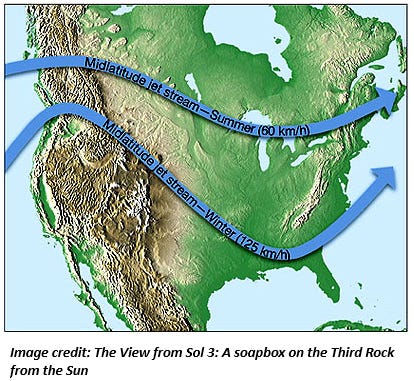
Much of what is presented as science is better described as unscientific quackery. Scientists generally rely on grants. Grants are most often given to validate some position (opinion) of a grantor.
The SIX climates in the northern hemisphere can be further divided into climates over the Pacific Ocean, Japan, Siberia, Europe, and Greenland.
Climates are the consequences of atmospheric rivers and oceanic rivers like the Gulf Stream, a subset of the Atlantic Meridional Overturning Circulation (AMOC).
What is the climate of the British Isles? There are two climates, one generally the product of the seasonal jet stream, the other a semitropical climate with palm trees.
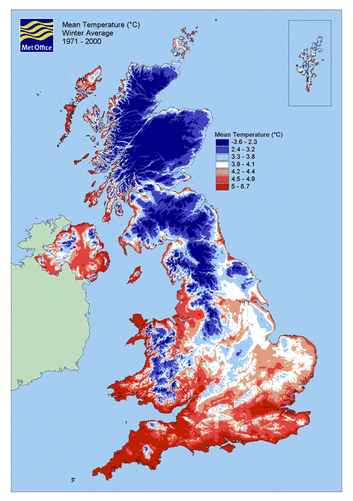
In the scientific realm of thinkers, climate refers to the long-term (30-year) conditions of the atmosphere at a regional scale. Weather refers to the short-term conditions of the atmosphere at the same locale.
The weather/climate over the British Isles is chiefly driven by the Gulf Stream (AMOC). There, palm trees are common.
Ocean Temperature(s)
What is a temperature? A temperature is a measure of the warmth or coldness of an object or substance with reference to some standard value. The temperature of two systems is the same when the systems are in thermal equilibrium.
What is the average temperature of a body of water or air? An average temperature is the aggregate of the measured temperatures of a defined area divided by the number of measured temperatures. For example, a measured temperature in Death Valley, California, was 110 °F. At the same time, the temperature in Los Angeles, California, was 68 °F. Therefore, the average temperature of Southern California was
[110 °F + 68 °F] ÷ 2 = 89 °F
Obviously, an average temperature is not the actual temperature of a real place.
One example: Frito-Lay. We want the most reasonable average temperature when controlling temperatures in the HVAC system. This is done at the Frito-Lay Headquarters building in Plano, Texas. The winter-time temperature control mechanisms are modulating outdoor air dampers and modulating return-air dampers.
The air intake filter is 8’ high, 50’ wide. 8’ X 50’ = 400 ft. square. We install one temperature sensor for every square foot, 400 temperature sensors. Could we not simply measure the air intake temperature at each end of the air intake opening? Yes, but the actual average temperature would be wildly unreasonable. Why? Temperature stratification from one end of the intake to the other can vary as much as 40 degrees in the wintertime. Motorized dampers modulate the outdoor airstream with the return airstream. The target (preferred) discharge temperature is 55 °F. The customer requires a high degree of accuracy for optimum comfort and indoor air quality.
Average temperatures do not exist in nature. Average temperatures do not work in commercial office buildings to manage personal comfort. I speak from experience.
Sources of Heat
Questions
- What is the depth of water at the North Pole? Answer: ~13,000 feet.
- What is the depth of water at the South Pole? Answer: none
The warmest air is near the Earth’s surface at or near the equator. The coldest air is at the highest altitudes. The warmest ocean water is near the surface, while the coldest water is at the depths of the ocean.
Question: Why are you not questioning the locations of warm and cold air? Doesn’t hot air rise and denser cold air sink?
Thermoclines
What is the surface temperature of the Pacific Ocean? It depends on the geographic location you have in mind.
Have you ever gone for a swim in a lake in the heat of Summer? Did you experience warm water around your upper body, cold water around your lower extremities? How is this possible?
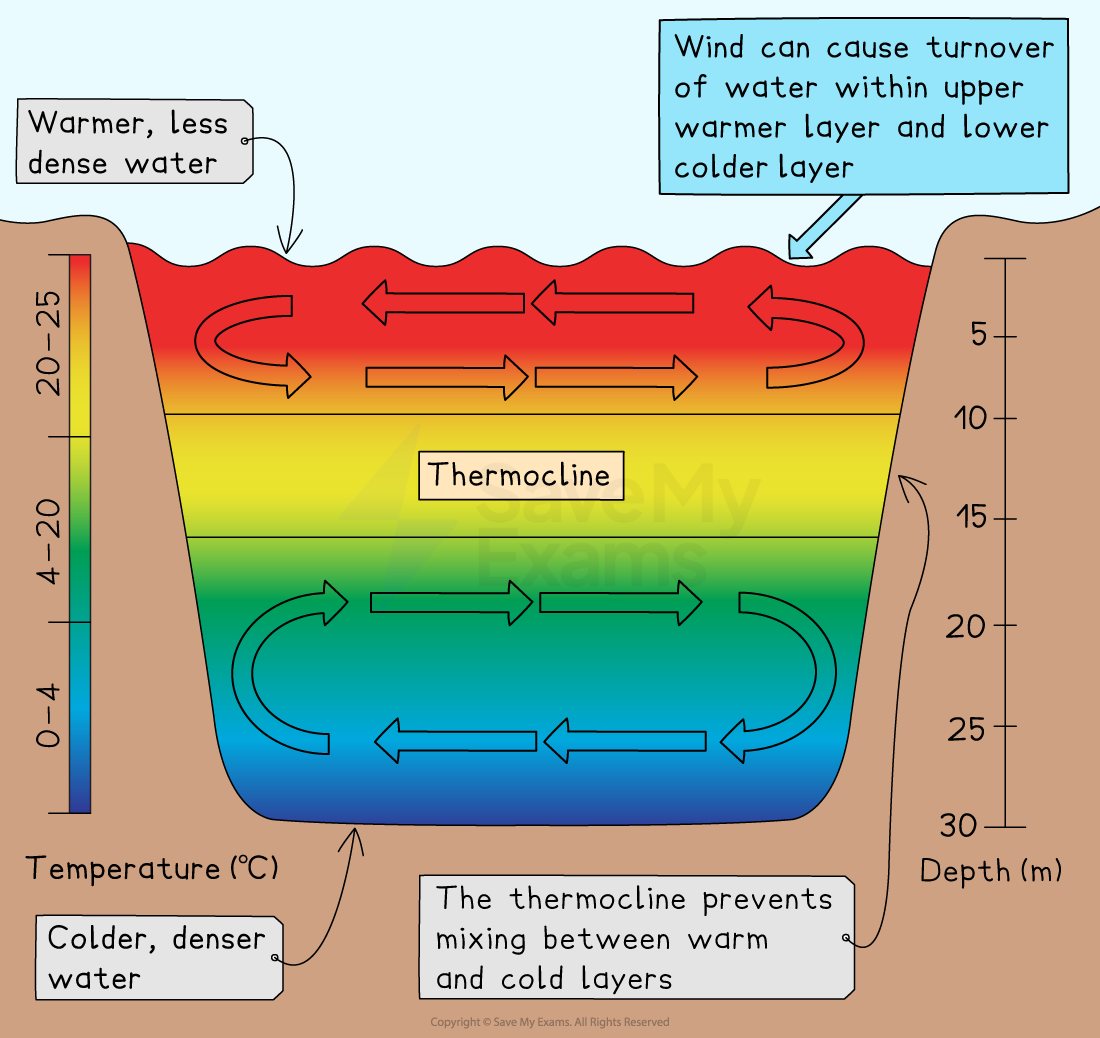
In general, lakes in the United States have thermoclines that form in the summer, as seen above. In the depths of winter, surface waters become colder than the deep water. The surface of a lake will become much colder in the winter than the cold water at the bottom of a lake. Because the surface water is now denser than the water at the bottom of the lake, lake inversion occurs.
Oceanic Thermoclines
Bodies of water are made up of layers, determined by temperature. The top surface layer is called the epipelagic zone, and is sometimes referred to as the “ocean skin” or “sunlight zone.” This layer interacts with the wind and waves, which mixes the water and distributes the warmth. At the base of this layer is the thermocline. A thermocline is the transition layer between the warmer mixed water at the surface and the cooler deep water below. It is relatively easy to tell when you have reached the thermocline in a body of water because there is a sudden change in temperature. In the thermocline, the temperature decreases rapidly from the mixed layer temperature to the much colder deep water temperature.
In the ocean, the depth and strength of the thermocline vary from season to season and year to year. It is semi-permanent in the tropics, variable in temperate regions (often deepest during the summer), and shallow to nonexistent in the polar regions, where the water column is cold from the surface to the bottom.
Thermoclines also play a role in meteorological forecasting. For example, hurricane forecasters must consider not just the temperature of the ocean’s skin (the sea surface temperature), but also the depth of warm water above the thermocline. Water vapor evaporated from the ocean is a hurricane’s primary fuel. The depth of the thermocline is the measure of the size of the “fuel tank” and helps to predict the risk of hurricane formation.
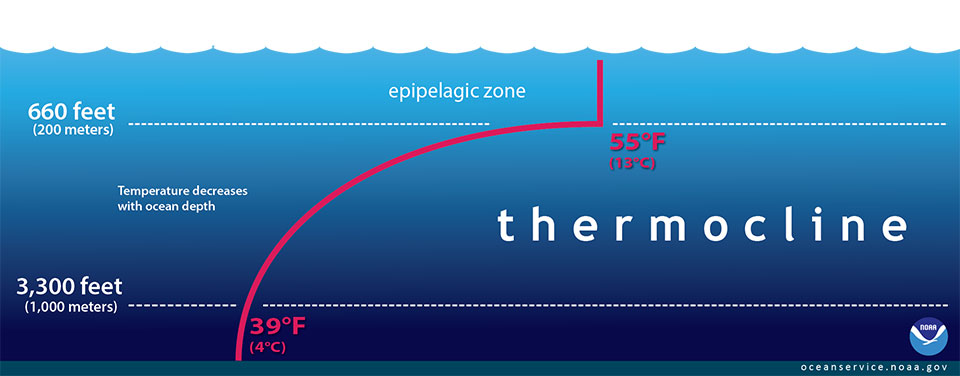
The deepest point in the Pacific Ocean is Challenger Deep, located within the Mariana Trench, which is the deepest point in the world’s oceans. Challenger Deep, first encountered in 1997, its depth has been reported variously as 34,911 and 35,463 feet (Britannica). The water in Challenger Deep has an average temperature of 39 °F.
Water has the usual property of contracting when the temperature decreases, but only down to 39.2°F (4°C); below that temperature it expands until it reaches 32°F (0°C). Thermodynamics: water
Resources
- The CO2 Coalition “The CO2 Coalition was established in 2015 as a 501(c)(3) for the purpose of educating thought leaders, policy makers, and the public about the important contribution made by carbon dioxide to our lives and the economy. The Coalition seeks to engage in an informed and dispassionate discussion of climate change, humans’ role in the climate system, the limitations of climate models, and the consequences of mandated reductions in CO2 emissions.”
- The Cornwall Alliance “The Cornwall Alliance is a network of evangelical Christian scholars—including theologians, natural scientists, economists, policy experts, and religious leaders—committed to promoting Biblical Earth stewardship, economic development for the poor, and the gospel of Jesus Christ.
We believe that responsible stewardship of the Earth means working together to enhance its fruitfulness, beauty, and safety, all for the glory of God and the benefit of our neighbors. We also advocate for policies that lift people out of poverty through principles such as private property rights, entrepreneurship, free trade, limited government, and access to abundant, affordable, and reliable energy.
At our core, we proclaim and defend the good news of salvation by grace through faith in Jesus Christ’s atoning death and victorious resurrection.” - National Oceanic and Atmospheric Administration (NOAA) “NOAA is an agency that enriches life through science. Our reach goes from the surface of the sun to the depths of the ocean floor as we work to keep the public informed of the changing environment around them.” Naturally, depending on the majority political party in power, unscientific biases emerge. I suggest using government information the way you eat fish: Eat the meat and spit out the bones.
- U.S. Geological Survey (USGS) “Created by an act of Congress in 1879, the USGS provides science for a changing world, which reflects and responds to society’s continuously evolving needs. As the science arm of the Department of the Interior, the USGS brings an array of earth, water, biological, and mapping data and expertise to bear in support of decision-making on environmental, resource, and public safety issues.”
- National Aeronautics and Space Administration (NASA) ”NASA explores the unknown in air and space, innovates for the benefit of humanity, and inspires the world through discovery. For more than 65 years, NASA has made the seemingly impossible, possible. At its 20 centers and facilities across the country and with U.S. commercial companies and international partners, NASA leads studying Earth science, including climate, our Sun, solar system, and the larger universe. We conduct cutting-edge research to advance technology and aeronautics. We operate the world’s leading space laboratory, the International Space Station, and will establish a sustainable and strong exploration presence on the Moon this decade through the Artemis campaign.”
- List of United States federal research and development agencies
To Be Continued
John White
Rockwall, Texas
 John N. White