
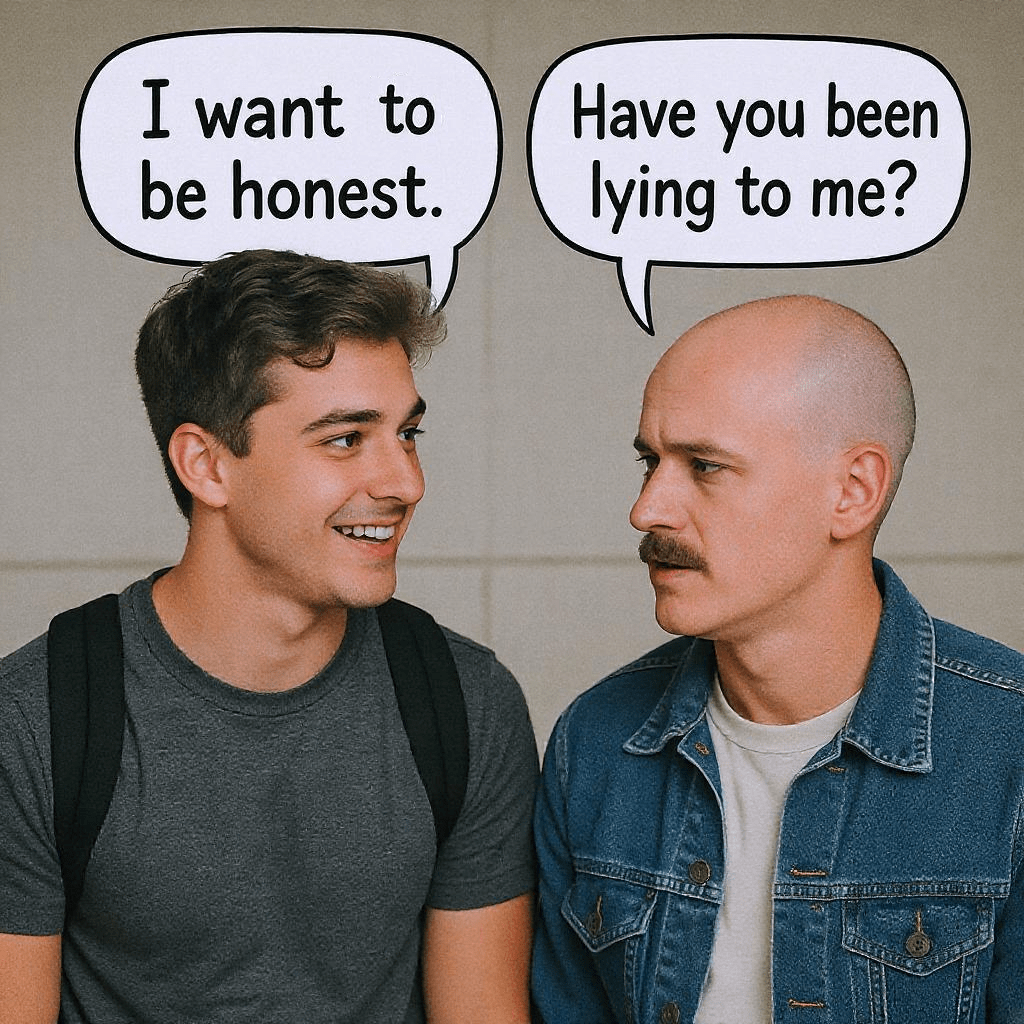
The fellow on the left wishes to speak frankly to the other fellow. The other fellow assumes the first has been lying to him.
Often, you and I will hear a similar conversation. Someone wishes to speak frankly but uses the word honest. Honesty and frankness are not synonyms.
Let’s explore definitions:
- frank: direct; holding nothing back; direct and unreserved in speech;
straightforward; without inhibition or subterfuge; direct
undisguised - honest: honorable in principles, intentions, and actions;
upright; truthful or creditable; honorable in principles, intentions, and actions;
upright and fair
I confess. Each time I hear someone use honest in place of frank, I am tempted to ask. “Have you been lying to me up to this point in time?” No. I don’t do it; I just think it. I imagine many people think as I do on this matter.
This is not to celebrate a pet peeve. It is to point to a fundamental failure of our public education system: illiteracy.
In 2024, estimates about the total number of words in the English language vary widely. Researchers from Harvard University and Google have suggested that there are over 1 million words in total. This number continues to grow, with thousands of new words being coined every year to describe new technological advancements, cultural shifts, and evolving societal norms.
International English Test: How Many Words Are in the English Language? [2025]
Am I being picky with the American English language? By no means. Illiteracy is a major problem for all Americans.
Adults with low literacy skills are far more likely to be under- or unemployed and therefore more likely to turn to criminal activities for financial survival. Children of parents with limited literacy skills are more likely not to graduate high school and end up in the criminal justice system.
Illiteracy and crime are connected. The Department of Justice states, “The link between academic failure and delinquency, violence, and crime is welded to reading failure. Over 70% of inmates in America’s prisons cannot read above a fourth-grade level.” [Read more here]
Governor’s Early Literacy Foundation: Early Literacy Connection to Incarceration
The ability to read is an essential skill for navigating the modern world, yet millions of adults in the United States have such poor literacy skills that they are unable to read basic sentences, fill out a job application form, or understand the instructions on their prescription labels.…
The numbers are staggering. As of 2022, ThinkImpact reports that an estimated 79% of American adults are literate. To put it another way, one out of every five American adults are functionally illiterate, meaning that today in the United States, almost 65 million people are unable to read basic sentences, fill out a job application form, or understand the instructions on their prescription labels. This is not merely a crisis of the illiterate, but also of the underliterate: a whopping 54 percent of all American adults read at or below a sixth grade level.
Excerpts from the Yale Human Rights Journal—Hidden in Plain Sight: The Secret Epidemic of Illiteracy in the United States
In my blog posts, I carefully select words that communicate a particular idea or fact. Words I know to be unfamiliar with most of my readers feature links to online dictionaries.
I am not quibbling over the nuances of truthfulness and frankness. Think of a healthy vocabulary as the key to less crime, fewer divorces, and, not least of all, misunderstandings.
How do Texas public schools compare with the rest of the nation in literacy? Take a deep breath and be seated before reading from the 2024 Annual Report—A National Comparison—Texas Education Agency
In closing, if you have elementary-age children. Your public library can set your children on a path to a successful life.
John White
Rockwall, Texas

 John N. White