
When did the question of birthright citizenship begin? For a short version, skip down to the Jurisdiction heading.
History
The United States began as a confederation of 13 states. The Articles of Confederation was the first Constitution. Under the Articles of Confederation, each state retained authority over the naturalization of aliens. This resulted in widely varying state practices, which James Madison in The Federalist No. 42 called a “fault” and “defect” of the Confederation. 1
The 1790 Naturalization Act provided that any
free white personwho residedwithin the limits and under the jurisdiction of the United Statesfor at least two years could be granted citizenship if he or she showedgood characterand swore allegiance to the Constitution. The law also provided that the children of naturalized citizens under the age of twenty-one at the time of their parents’ naturalization and who were residing in the United States would be considered U.S. citizens. The children of U.S. citizens who were born outside the United States were deemed U.S. citizens unless their fathers had never resided in the United States. Additionally, Congress delegated to the courts the power to administer the naturalization process. 2
In 1795 Congress amended the naturalization law by requiring an applicant to submit a declaration of intent to become a citizen at least three years before naturalization, and extending the minimum residence requirement to five years. 2
The Civil War began on April 12, 1861, and officially ended on April 9, 1895. Historians generally describe the war as disputes on slavery and states’ rights. I firmly believe the war was 100% due to the singular dispute over slavery.
Up to and throughout the Civil War citizenship was unavailable to non-white persons.
On December 6, 1865, the 13th Amendment was ratified. This amendment abolished slavery, but former slaves and their offspring were not eligible for citizenship.
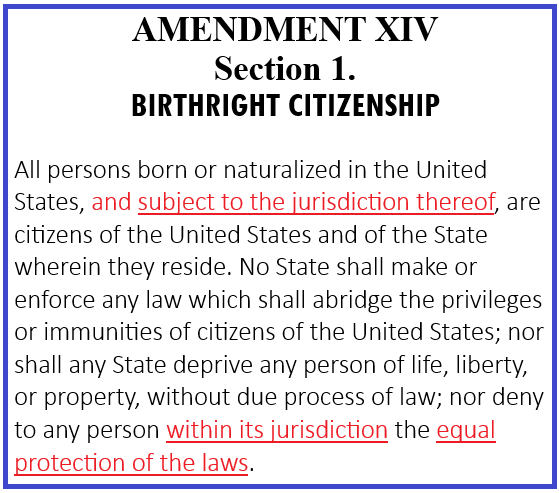
The 14th Amendment, amended on July 9, 1868, confers citizenship to former slaves and their children.
All persons born or naturalized in the United States, and, subject to the jurisdiction thereof, are citizens of the United States and of the State wherein they reside. No State shall make or enforce any law which shall abridge the privileges or immunities of citizens of the United States; nor shall any State deprive any person of life, liberty, or property, without due process of law; nor deny to any person within its jurisdiction the equal protection of the laws.
American Indian Citizenship
… on June 2, 1924, the United States government conferred citizenship on Native American people by passing the Snyder Act, also known as the Indian Citizenship Act. Prior to that time, Native Americans had been explicitly denied citizenship—first in the United States Constitution and, later, through the 14th Amendment. 8
Jurisdiction
A citizenship dispute refined the meaning of “subject to the jurisdiction.”
United States v. Wong Kim Ark, 169 U.S. 649 (1898), is a landmark decision[3] of the U.S. Supreme Court which held that “a child born in the United States, of parents of Chinese descent, who, at the time of his birth, are subjects of the Emperor of China, but have a permanent domicile and residence in the United States, and are there carrying on business, and are not employed in any diplomatic or official capacity under the Emperor of China”, automatically became a U.S. citizen at birth.
Explanation
Wong Kim Ark was born in the USA. His parents were Chinese citizens who lawfully and permanently resided in California at the time of Mr. Wong’s birth. As lawful immigrants and lawful residents, Kim’s parents were subject to the jurisdiction of the United States.
Originalist Viewpoint
On inauguration day, President Trump signed an Executive Order to limit birthright citizenship. That Executive Order, “Protecting the Meaning of and Value of American Citizenship,” seeks to establish a policy that birthright citizenship shall not be extended to those unlawfully or temporarily in the country, and thus “not subject to the jurisdiction” of the United States (per the Fourteenth Amendment to the U.S. Constitution). In the Order, originally slated to go into effect February 19, the President prohibited federal agencies from issuing documents recognizing U.S. citizenship, or accepting documents issued by state or local jurisdictions purporting to recognize U.S. citizenship, to a person when:
- The mother was illegally in the United States and the father was not a U.S. citizen or lawful permanent resident at the time of birth, or
- The mother’s presence in the United States was lawful but temporary, and the father was not a United States citizen or lawful permanent resident at the time of birth. 7
The Fallacy of Birthright Citizenship for Illegal Aliens
Related news story: VOA News, January 27, 2025: Woman gets more than 3-year prison term in ‘US birthright tourism’ case
Contrary to popular belief, the 14th Amendment doesn’t say that all people born in the U.S. are citizens. Legislative history shows that Congress intended the Fourteenth Amendment to eliminate permanent race-based barriers to citizenship. The president has the authority to direct federal agencies to act in accordance with the original meaning of the 14th Amendment. 9
Federal Immigration Law
8 USC 1325: Improper entry by alien
(a) Improper time or place; avoidance of examination or inspection; misrepresentation and concealment of facts
Any alien who (1) enters or attempts to enter the United States at any time or place other than as designated by immigration officers, or (2) eludes examination or inspection by immigration officers, or (3) attempts to enter or obtains entry to the United States by a willfully false or misleading representation or the willful concealment of a material fact, shall, for the first commission of any such offense, be fined under title 18 or imprisoned not more than 6 months, or both, and, for a subsequent commission of any such offense, be fined under title 18, or imprisoned not more than 2 years, or both.
(b) Marriage fraud
Any individual who knowingly enters into a marriage for the purpose of evading any provision of the immigration laws shall be imprisoned for not more than 5 years, or fined not more than $250,000, or both.
(c) Immigration-related entrepreneurship fraud
Any individual who knowingly establishes a commercial enterprise for the purpose of evading any provision of the immigration laws shall be imprisoned for not more than 5 years, fined in accordance with title 18, or both.
Illegal immigration is a federal crime.
Further Study
For further study, download (PDF format) WHO GETS TO BE AN AMERICAN?, a timeline from 1781 to the present. This document was created by GRANTMAKERS CONCERNED WITH IMMIGRANTS AND REFUGEES. The historical dates in this document are correct but the worldview is decidedly in error.
The organization is a leftist organization that claims our federal government is anti-immigrant. This is untrue. Our laws give a lawful path to citizenship for persons who legally enter our country. Some people groups wish to transform our country as presently happens in some European countries; England for example. Jews are fleeing England which is undergoing a transformation from a Judaeo-Christian society to an Islamic society hostile to Jews.
Our usual and customary citizenship process helps assimilate foreign cultures. It realigns them to our American heritage and historical values. At the end of his term of office in 2024, President Joe Biden directed the USCIS to hasten the citizenship process. 5 This act will have deleterious effects on our country.
References
- The Heritage Foundation, Congress and the Naturalization of Immigrants
- Constitution Annotated Article S8.C4.1.2.3 Early U.S. Naturalization Laws
- Way Back Machine, August 31, 2015, Donald Trump meet Wong Kim Ark, the Chinese American cook who is the father of ‘birthright citizenship’
- The Heritage Foundation, The Birthright Citizenship Clause Too Many Forget, but Trump Is Right To Question
- Capitalism Institute, August 13, 2024, Citizenship Approval Hits Decade High Under Biden-Harris Administration
- CNN Politics, November 7, 2024, Federal judge strikes down Biden immigration policy shielding select undocumented spouses of US citizens from deportation
- Federation For American Immigration Reform, March 17, 2025, Trump Administration Petitions Supreme Court Over Birthright Citizenship
- Native American Rights Fund, June 4, 2024, The Indian Citizenship Act at 100 Years Old
- VOA News, January 27, 2025: Woman gets more than 3-year prison term in ‘US birthright tourism’ case
John White
Rockwall, Texas

 John N. White