
The Supremacy Clause
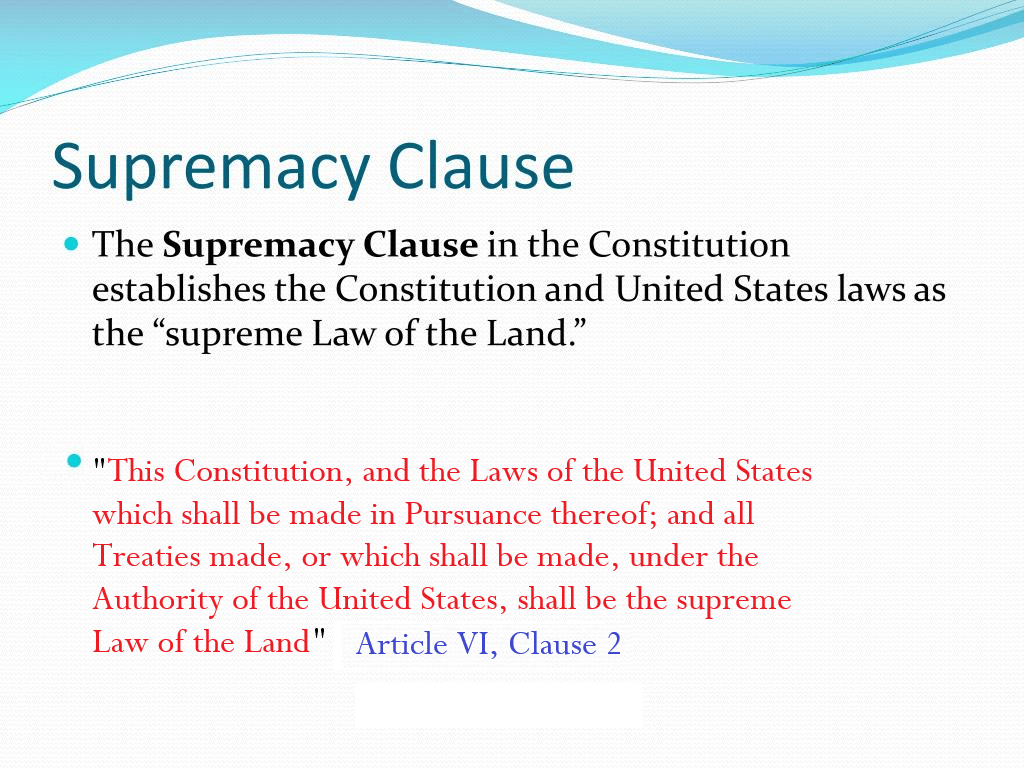
The second clause of Article 6 of the U.S. Constitution defines the Supreme Law of the Land.
I quote:
“This Constitution, and the Laws of the United States which shall be made in Pursuance thereof; and all Treaties made, or which shall be made, under the Authority of the United States, shall be the supreme Law of the Land; and the Judges in every State shall be bound thereby, any Thing in the Constitution or Laws of any State to the Contrary notwithstanding.“
End quote.
Our republican form of government features three branches: the Legislative, the Executive, and the Judiciary.
As per Article 4, Section 4 of the Constitution, the states must also have a republican form of government. Hence, the broad definitions of the branches of government apply to both Federal and State governments.
The Legislative branch, Article 1, creates laws and funds the government . The Executive branch, Article 2, exclusively executes and enforces laws. What is the role of the Judicial branch, Article 3?
The fundamental purpose of the Judicial branch is to settle disputes. Federal and State courts can neither create nor enforce laws. Disputes can be civil or criminal matters.
Attorneys use the term “case law.” Case law does not follow the Supremacy Clause. Case law is a court opinion or finding. It has the effect of law until the opinion is challenged on appeal to a higher court. Case law is not de facto law.
If you want to test the authority of a court order, disobey it. This is the quickest way to find out.
Is it automatically constitutional if Congress or a state legislature creates a law, and the President or Governor signs it? No. Remember the rule of the Supremacy Clause.
All laws must be “in pursuance of the Constitution.”
Can we name even ONE unconstitutional federal law? Yes, we can name one, and many more.
One example of an unconstitutional law is the Elementary and Secondary Education Act of 1965. Another example is the Department of Education Organization Act of 1979. The first was a product of LBJ’s Great Society socialistic program. The second involved a payoff from the National Education Association (NEA) for financially supporting President Jimmy Carter’s election.
Were either of these two laws constitutional? How would you know? Search Article 1, Section 8 of the U.S. Constitution. This section is known as the Enumerated Powers of Congress. You will find absolutely no mention of education in the Constitution. Do you remember the definition of the Supreme Law of the Land? Neither of the aforementioned laws is in pursuance of the Constitution.
Just because someone says an act of government is “the law,” it does not make it constitutional. This applies to any of the three branches.
Knowledge is power.
 John N. White