
Prohibition of government overreach protects the states and persons. Such prohibitions guard against any law, administrative rule, or court judgment that would extinguish civil rights.
Article 1, Section 9 of the Constitution prohibits Bills of Attainder by Congress. Article 1, Section 10 prohibits Bills of Attainder by State Legislatures.
Bills of Attainder are laws that punish an individual, a corporation, or a labor union without a trial. The word attainder derives from an Anglo-French word meaning “a conviction.”
The British government became increasingly restrictive of individual freedoms in the American colonies. This occurred in the years leading up to the American Revolution. Our forefathers were English citizens entitled to rights in the Magna Carta of 1215.
King George III ruled England and Ireland. The French and Indian War dramatically increased the British Empire’s national debt. Parliament chose to heavily tax the colonies. As the colonists resisted dramatic and unequal taxation, the British government imposed even more restrictions on the colonies. The Bill of Rights, the first ten amendments to the Constitution, was born from memories of that tyrannical experience. Those memories directly influenced its creation.
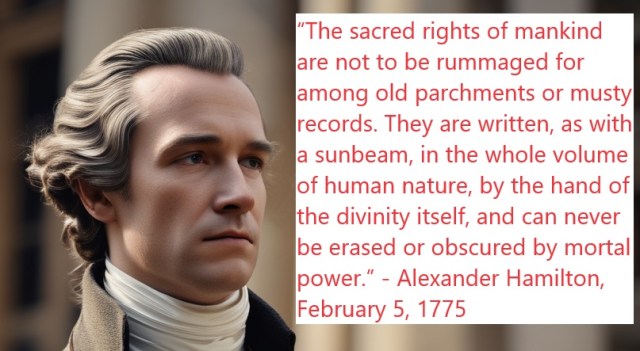
Founding Father Alexander Hamilton was a proponent of a strong central government. Nevertheless, he ardently opposed King George’s taxes, saying, “Under the auspices of tyranny the life of the subject is often sported with. The fruits of his daily toil are consumed in oppressive taxes, that serve to gratify the ambition, avarice, and lusts of his superiors.” Every court minion riots in the spoils of the honest laborer, and despises the hand by which he is fed. The page of history is replete with instances that loudly warn us to beware of slavery.“
[Presenter: If time permits, I suggest showing a 1964 YouTube video of Ronald Reagan’s speech, “A Time for Choosing.”]
Ronald Reagan, in his speech titled “A Time for Choosing,“ quoted a Cuban refugee from Castro’s communist Cuba. Consider an excerpt of that famous speech:
“Not too long ago, two friends of mine were talking to a Cuban refugee, a businessman who had escaped from Castro, and in the midst of his story one of my friends turned to the other and said, “We don’t know how lucky we are.” And the Cuban stopped and said, “How lucky you are? I had someplace to escape to.” And in that sentence he told us the entire story. If we lose freedom here, there’s no place to escape to. This is the last stand on earth.“
In 1964, the United States national debt was $311,712,899,257.30. Today, the national debt is greater than $35 trillion.
In 1824, Thomas Jefferson, the small government advocate, wrote to a friend, “I think myself that we have more machinery of government than is necessary, too many parasites living on the labor of the industrious. Government big enough to supply everything you need is big enough to take everything you have … The course of history shows that as a government grows, liberty decreases. The two enemies of the people are criminals and government, so let us tie the second down with the chains of the constitution so the second will not become the legalized version of the first.“
Cuban poet and philosopher José Martí [1853-1895] famously said, “The first duty of a man is to think for himself.”
 John N. White