

My Story
In 1972, while assigned to the USS Constellation (CVA-64), the ship had a major mechanical breakdown that necessitated departure from the war zone. While near the equator, pilots regularly flew touch-and-go and full-stop practice flights to keep their aviator skills at their best.
In the debriefing room, I heard stories of pilots encountering 85-degree temperatures above 20,000 feet MSL. My personal experiences as a passenger were all over CONUS (the continental United States). At 10,000 above MSL, you can freeze your body parts. At 20,000, you can become a human hailstone.
ARPANET, the progenitor of the Internet, was introduced in 1972. The Internet was not available. I resorted to my company’s library and hours of thinking. Lacking internet service, a yet-to-be information resource, it was memories of Mom’s Sunbeam Mixmaster that revealed to me how the atmosphere behaves along the equator.
Ancient mariners called the phenomenon “The Doldrums;” a double air curtain in which the airflow direction is up.
A down-to-earth geological review is a sensible starting point for a discussion of atmospheric phenomena. Why?
I point to an outdated NASA article titled History of the Ozone Hole, in which scientific observations of the ozone (O3) immediately brought about the attribution of the depletion of ozone to industrial chemicals.
Your wife’s hairspray and refrigerants became overnight chemical villains for the depletion of ozone over Antarctica.
My simple understanding of global airflow patterns caused me to say aloud, “This is not possible.” I endured the scorn and ridicule, secure in my knowledge that our industrial chemicals could not deplete ozone over Antarctica.
I called an expert on volcanoes, a tenured professor at a prestigious university, and a Baylor PHD, to test my theory of subsea volcanoes around Antarctica spewing metric tons of chlorofluorocarbons (CFCs). I learned from him the source of the CFCs neutralizing the ozone is primarily Mount Erebus on the continental divide between Eastern Antarctica and Western Antarctica.
A December 2015 article published on Science Direct titled The Antarctic ozone depletion caused by Erebus volcano gas emissions reveals: “Thus, Erebus volcano is the natural and powerful source of additional stratospheric HCl and SO2, and hence, the cause of the Antarctic ozone depletion, together with man-made chlorofluorocarbons.” The latter phrase was added to satisfy the climate alarmists in the Executive Administration.

Along the way to this moment in time, the discovery of the Chemical Equator in 2008 scientifically proves that industrial chemicals in the Northern Hemisphere do not and cannot affect the ozone over Antarctica. You can read numerous publications on this subject:
- Live Science, September 30, 2008: Earth’s Air Divided by Chemical Equator
- Online Encyclopedia Britannica: chemical equator
- New Scientist, September 23, 2008: ‘Chemical equator’ protects Antarctica’s clean air
Your Personal Experiences Reveal Much, If You Pay Attention
Recently, we were seated ringside for a total solar eclipse. If you were outside like most of us, you experienced the darkness. The darkness was such that outside lighting in our office complex and the shopping center across the street illuminated.
What did you notice most? Was it the darkness? Another feature of the eclipse experience can profoundly affect the way you think about the claims of anthropogenic global warming. Did you notice the fast temperature drop? If you remained outdoors when the sun reappeared, you would have noticed a sudden rise in temperature.
Sunlight and the rotation of the Earth about its access are two big factors in the atmosphere. In general, there are 10 hours of temperature rise from sun up to about 5 pm followed by 14 hours of temperature fall overnight.
Why do I know this? Back in the 1970s, while with the Honeywell Commercial division, it was my responsibility to set up an automatic temperature control system for the Dallas Zoo reptile building. Due to import restrictions on many species of reptiles and snakes zoos were quickly evolving into snake breeding facilities. A local engineer, Jack Roberts, had a record of hour-by-hour temperature in Lubbock, Texas from a study he did. The zoo people assumed they needed to replicate night and day temperature profiles in order for their breeding stock of snakes to reproduce.
Your Personal Atmosphere
In still, unperturbed air, the gasses seek an altitude based on their respective molar weights. The keyword is unperturbed: placid, undisturbed.
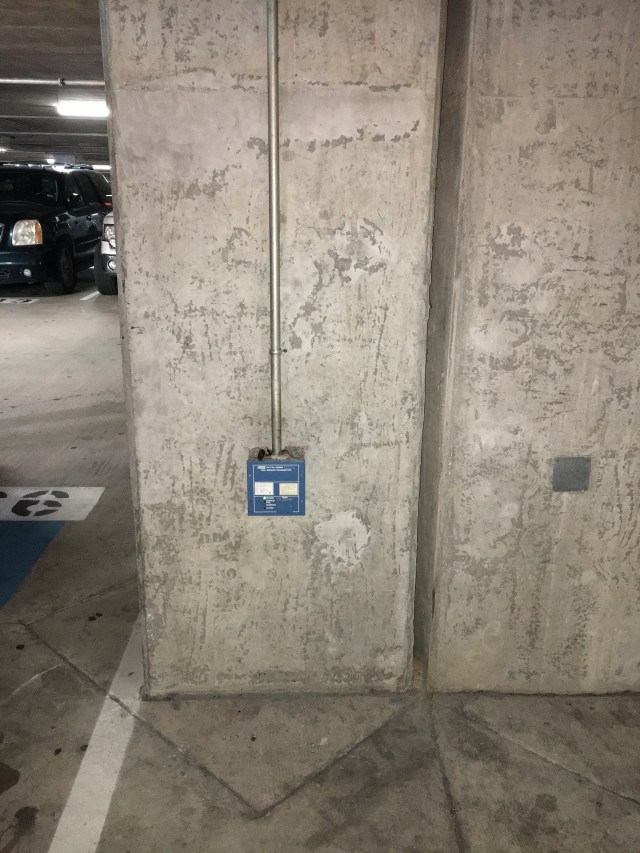
Most buildings and parking garages will have unperturbed air, such as the parking garage at the Grapevine Mills Mall. This little blue box in the photo is a carbon-monoxide detector. In my business, we have installed innumerable such sensors to protect people from carbon monoxide poisoning. But, I always install them 6 to 8 feet above the floor because carbon-monoxide gas is lighter than air. By the time the pictured sensor detects a dangerous concentration of the deadly gas, it will be too late for anyone to help.
The sallyports in jails, prisons, and some courthouses are critical to all personnel. Officers often leave running their automobiles as they collect their records and equipment before leading a prisoner into a jail or courtroom. The danger is present in homes with open, unvented gas heaters.
Indoors, carbon dioxide (CO2) is heavier than air. I always install CO2 sensors 4 feet above the finished floor. Why not lower them? In the world of construction, you have to deal with codes regulating the elevation of thermostats.
Atmospheric Airflow Patterns
Unlike the unperturbed indoor atmospheres of occupied buildings, our atmosphere is greatly perturbed, diffusing the constituent gasses at all latitudes.
There are six airflow cycles, three in the northern and three in the southern hemispheres. The force of gravity pulls cool air downward, displacing warm air upward. Sunlight heats the surface of the Earth, heating gases and causing them to rise. The disturbed atmosphere prevents gasses from settling out in sedimentary layers.
Oxygen and carbon dioxide quickly heat up at the surface. Nitrogen, not so much. Therefore, the mixture of gasses is somewhat uniform from the surface of the Earth to the Exosphere.
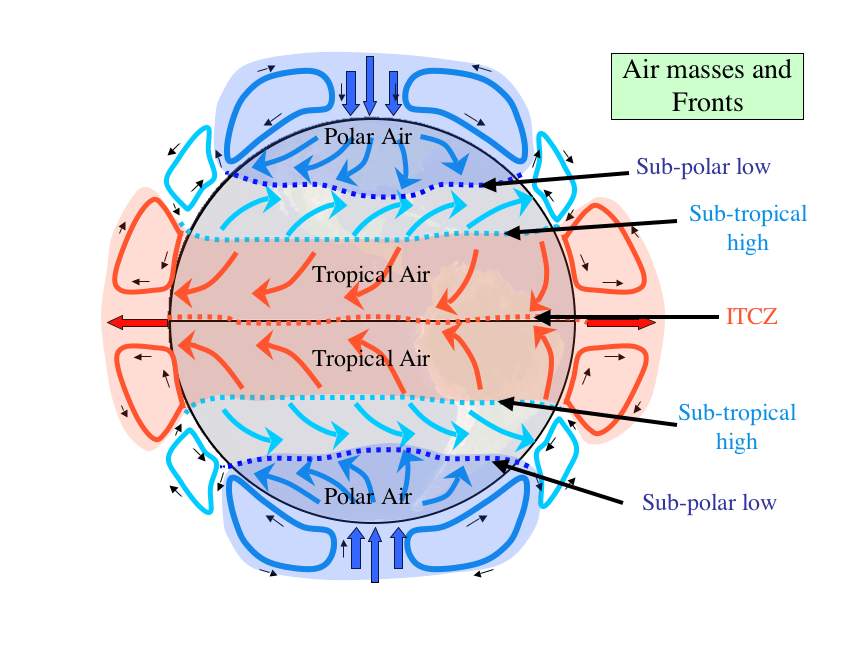
The arrows in the Global Atmospheric Circulation video depict the Coriolos Effect.
The Influences of Arctic and Antarctic Ice on Weather
NOAA reports, “The sea ice area for the Arctic shows near-record minimums since 2002.”

Wow! Loss of Arctic sea ice suggests ‘global warming,’ right? What would you expect to happen downstream? Warmth melts sea ice, territories to the east, downwind will also be warmer, Right?
Headline: Nature Geoscience, April 1, 2021: Arctic sea-ice loss fuels extreme European snowfall
“The loss of Arctic sea ice has been implicated with severe cold and snowy mid-latitude winters. However, the mechanisms and a direct link remain elusive due to limited observational evidence…Here we present atmospheric water vapor isotope measurements from Arctic Finland during ‘the Beast from the East’—a severe anticyclonic outbreak that brought heavy snowfall and freezing across Europe in February 2018. We find that an anomalously warm Barents Sea, with a 60% ice-free surface, supplied up to 9.3 mm d−1 moisture flux to this cold northeasterly airflow. We demonstrate that approximately 140 gigatonnes of water were evaporated from the Barents Sea during the event, potentially supplying up to 88% of the corresponding fresh snow over northern Europe.” Read more.
Natural Cycles
- The Carbon Cycle | The carbon cycle describes how carbon transfers between different reservoirs located on Earth. This cycle is essential for maintaining a stable climate and carbon balance on Earth.
- The Water Cycle | The continuous circulation of water in the Earth-atmosphere system. Of the many processes involved in the water cycle, the most important are evaporation, transpiration, condensation, precipitation, and runoff. Although the total amount of water within the cycle remains essentially constant, its distribution among the various processes is continually changing.
- Milankovitch Cycles | In the early 1900s, Serbian geophysicist and astronomer Milutin Milankovitch documented variations in the Earth’s rotation over extensive periods. Milankovitch concluded that subtle variations in the planet’s orbit over thousands of years could indeed produce noticeable fluctuations in Earth’s temperatures.
- Planetary Orbital Cycles | Historical data suggest a relation between the changing level of solar activity and climatic change on Earth. Since there is also evidence that the solar cycle of activity is influenced by the alignments of the planets, through tidal interactions with the Sun, it seems that climatic change might be predicted by studying these alignments.
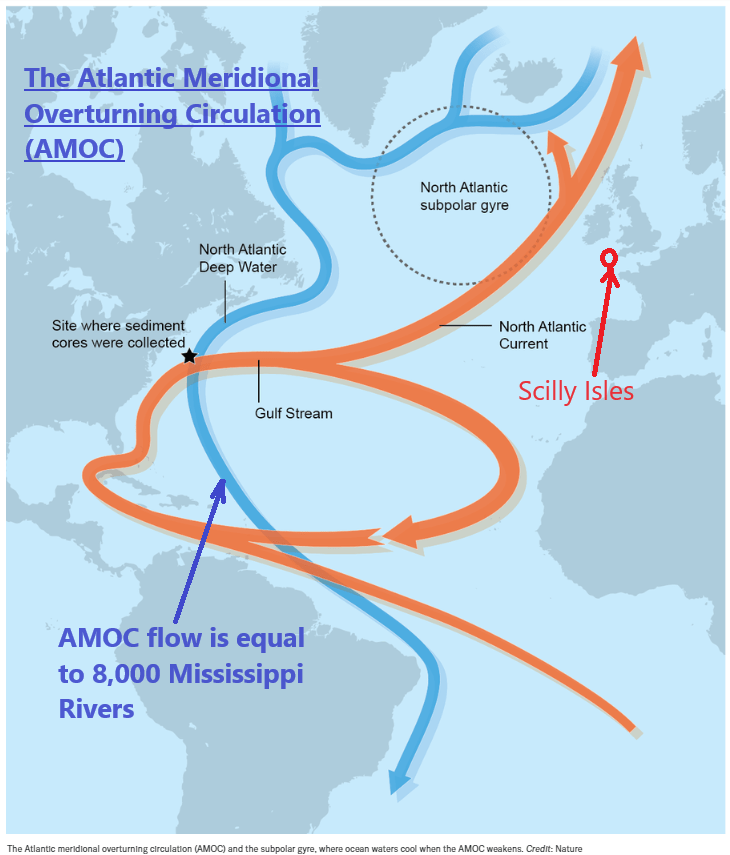
- Oceanic Currents | Ocean currents, including the ocean conveyor belt, play a key role in determining how the ocean distributes heat energy throughout the planet, thereby regulating and stabilizing climate patterns.
- Geological Cycles | (a) The ENSO (El Nino Southern Oscillation) affects the climate over North and South America: geologically based Plate Climatology Theory states that fixed, non-moving geological forces influence/generate many climate events, including El Ninos and La Ninas. (b) Warm and Cold Episodes in Western Pacific Warm Pool and Their Linkage With ENSO Asymmetry and Diversity | The western Pacific warm pool (WPWP), the heart of earth ocean-atmosphere system, is the warmest area of the open oceans and global heat reservoir. Its sea surface temperature (SST) is usually warmer than 28°C accompanied by active deep convection.
- Volcanic Influences on Climate | The co-called Doomsday Glacier, Thwaite’s Glacier is melting. “Ice losses from Thwaites Glacier in West Antarctica are currently responsible for roughly four percent of the global sea-level rise. This figure could increase, since virtually no another ice stream in the Antarctic is changing as dramatically as the massive Thwaites Glacier. Until recently, experts attributed these changes to climate change and the fact that the glacier rests on the seafloor in many places, and as such comes into contact with warm water masses. But there is also a third, and until now, one of the most difficult to constrain, influencing factors. In a new study, German and British researchers have shown that there is a conspicuously large amount of heat from Earth’s interior beneath the ice…”
- Ocean Circulation ‘conveyor belts’ | (1) The Atlantic Meridional Overturning Circulation (AMOC) and the (2) global Ocean Circulation (conveyor belts) stabilize the Earth’s climate. The physics of the ‘conveyor belts’ involve thermoclines (differences between the temperature of warm water and cold water that separate the two bodies vertically) and thermohaline circulation controlled by horizontal distances in temperature and salinity.
- Atmospheric gasses
What are the ‘greenhouse gasses’? NOAA describes the atmosphere without water and with water.



The Ice Age
Here is a story from the opposite side of the world from Antarctica, the story of Glacier Girl. This short video has a beneficial effect on the theory of anthropogenic global warming.
The P38 Association published a detailed story about the ferry flight crash landing on a Greenland glacier. Glacier Girl: History
The Lost Squadron touched down on the icy surface of Greenland in 1942. After 12 unsuccessful attempts to locate the aircraft, 50 years after the 1942 crash landing, the 13th attempt successfully recovered the P-38 that would be known as Glacier Girl was recovered from 268 feet of ice.
268 ÷ 50 = 5.36 feet of ice accumulation per year
In 1988, 36 years ago (the date of my report is June 17, 2024), PBS reported on June 23, 2018, “Global Warming First Made Headline News.”
The video also challenges the theory of evolution and the theory of an ancient Earth Carl Sagan used to describe as “beelions and beelions” of years old. I point to the evidence of the multiple layers of ice each year.
Counter Intuitive Expectations
In the news: May 24, 2024, NASA Mission Flies Over Arctic to Study Sea Ice Melt Causes
Excerpt: “An important goal of ARCSIX is to better understand the surface radiation budget — the energy interacting with the ice and the atmosphere,” said Rachel Tilling, a campaign scientist from NASA’s Goddard Space Flight Center in Greenbelt, Maryland.
The key phrase: “to better understand the surface radiation budget”
If Arctic sea ice is melting, what would you expect to happen to northern lands? The answer will surprise you.
A scientific essay published on Nature.com, titled Arctic sea-ice loss fuels extreme European snowfall reports, “The loss of Arctic sea-ice has been implicated with severe cold and snowy mid-latitude winters. However, the mechanisms and a direct link remain elusive due to limited observational evidence. Here we present atmospheric water vapour isotope measurements from Arctic Finland during ‘the Beast from the East’—a severe anticyclonic outbreak that brought heavy snowfall and freezing across Europe in February 2018. We find that an anomalously warm Barents Sea, with a 60% ice-free surface, supplied up to 9.3 mm d−1 moisture flux to this cold northeasterly airflow. We demonstrate that approximately 140 gigatonnes of water [were] evaporated from the Barents Sea during the event, potentially supplying up to 88% of the corresponding fresh snow over northern Europe.”
The government weather agency NOAA features A Near-Realtime Arctic Change Indicator Website. Would you expect colder, icier winters in European countries due to the melting of Arctic sea ice?
Scientia Potentia Est – Knowledge Is Power
From 1974 until my recent retirement a few years ago, my business was developing indoor climates for human habitations, such as office buildings, hospitals, a zoo, educational facilities, military installations, morgues, and laboratories, both medical and research facilities.
Fear is a powerful motivator. Genuine scientific research moves us from fear-based thinking to sound thinking.

Science is not a “consensus” but a tried-and-true process in which a researcher hypothesizes and then labors to defeat the hypothesis.
:max_bytes(150000):strip_icc():format(webp)/TC_606045-steps-of-the-scientific-method-p2-5ac785b7ff1b78003704fcc9.png)
Serious scientists do not huddle together to develop a consensus on the cause of some phenomenon. Scientists do not ‘vote’ on a hypothesis they follow the scientific method to test a hypothesis.
Thankfully, your personal desire to know the truth of a matter and the availability of the Internet, with its vast stores of knowledge, enables you to be a scientist pro tempore.
John White
Rockwall, Texas

Helpful Resources
- The CO2 Coalition — Providing the facts about CO2 and climate change. CO2 Coalition is the nation’s leading organization providing facts, resources, and information about the vital role carbon dioxide plays in our environment
- The National Oceanic and Atmospheric Administration (NOAA)
- The National Air and Space Administration (NASA)
- Oceans @ MIT
- MIT Earth, Atmosphere, and Planetary Sciences
- Answers in Genesis: Creation Science
- Jonathan Park: Modern-Day Scientists Who Believe in Creation
- Book, authored by Gregory Wrightstone, available from Amazon — A Very Convenient Warming: How modest warming and more CO2 are benefiting humanity, Paperback – January 2, 2024
 John N. White