
What is Sharia?
Islamic Law (Sharia)
Sharia, or sharia law, is the Islamic legal system derived from the religious precepts of Islam, particularly the Quran and the Hadith. The term sharia comes from the Arabic language term sharīʿah, Arabic: شريعة which means a body of moral and religious law derived from religious prophecy, as opposed to human legislation.
Sharia deals with many topics, including crime, politics, and economics, as well as personal matters such as sexual intercourse, hygiene, diet, prayer, everyday etiquette and fasting. Adherence to sharia has served as one of the distinguishing characteristics of the Muslim faith historically. In its strictest and most historically coherent definition, sharia is considered in Islam as the infallible law of God.
There are two primary sources of sharia: the Quran, and the Hadiths (opinions and life example of Muhammad). For topics and issues not directly addressed in these primary sources, sharia is derived. The derivation differs between the various sects of Islam (Sunni and Shia), and various jurisprudence schools such as Hanafi, Maliki, Shafi’i, Hanbali and Jafari. The sharia in these schools is derived hierarchically using one or more of the following guidelines: Ijma (usually the consensus of Muhammad’s companions), Qiyas (analogy derived from the primary sources), Istihsan (ruling that serves the interest of Islam in the discretion of Islamic jurists) and Urf (customs).
See Also: Allah | American Muslims | Compassion | Education | Government And Politics | Humanity | Interfaith | Islam | Justice | Knowledge | Love | Madinah (Medina) | Makkah (Mecca) | Nature And Environment | Prophet Jesus (Isa) | Prophet Muhammad (S) | Quran | Ramadan | Spirituality | Tolerance
Naturalization Oath of Allegiance to the United States of America
Oath
“I hereby declare, on oath, that I absolutely and entirely renounce and abjure all allegiance and fidelity to any foreign prince, potentate, state, or sovereignty, of whom or which I have heretofore been a subject or citizen; that I will support and defend the Constitution and laws of the United States of America against all enemies, foreign and domestic; that I will bear true faith and allegiance to the same; that I will bear arms on behalf of the United States when required by the law; that I will perform noncombatant service in the Armed Forces of the United States when required by the law; that I will perform work of national importance under civilian direction when required by the law; and that I take this obligation freely, without any mental reservation or purpose of evasion; so help me God.”
Note: In certain circumstances there can be a modification or waiver of the Oath of Allegiance. See the USCIS Policy Manual.
The principles embodied in the Oath are codified in Section 337(a) in the Immigration and Nationality Act (INA), which provides that all applicants shall take an oath that incorporates the substance of the following:
- Support the Constitution;
- Renounce and abjure absolutely and entirely all allegiance and fidelity to any foreign prince, potentate, state, or sovereignty of whom or which the applicant was before a subject or citizen;
- Support and defend the Constitution and laws of the United States against all enemies, foreign and domestic;
- Bear true faith and allegiance to the same; and
- A. Bear arms on behalf of the United States when required by the law; or
B. Perform noncombatant service in the Armed Forces of the United States when required by the law; or
C. Perform work of national importance under civilian direction when required by the law.
The language of the current Oath is found in the Code of Federal Regulations Section 337.1 and is closely based upon the statutory elements in Section 337(a) of the INA.
Additional Resources:
- History of the Oath of Allegiance
- U.S. Constitution, Article IV, Section 4, stipulates “The United States shall guarantee to every State in this Union a Republican Form of Government…”
- U.S. Constitution, Article VI, the second clause: the legal definition of the Supreme Law of the Land
This Constitution, and the Laws of the United States which shall be made in Pursuance thereof; and all Treaties made, or which shall be made, under the Authority of the United States, shall be the supreme Law of the Land; and the Judges in every State shall be bound thereby, any Thing in the Constitution or Laws of any State to the Contrary notwithstanding.
- Unconstitutional Official Acts — The Constitution Center
The general misconception is that any statute passed by legislators bearing the appearance of law constitutes the law of the land. The U.S. Constitution is the supreme law of the land, and any statute, to be valid, must be In agreement. It is impossible for both the Constitution and a law violating it to be valid; one must prevail. This is succinctly stated as follows:
The General rule is that an unconstitutional statute, though having the form and name of law is in reality no law, but is wholly void, and ineffective for any purpose; since unconstitutionality dates from the time of it’s enactment and not merely from the date of the decision so branding it. An unconstitutional law, in legal contemplation, is as inoperative as if it had never been passed. Such a statute leaves the question that it purports to settle just as it would be had the statute not been enacted.
Since an unconstitutional law is void, the general principles follow that it imposes no duties, confers no rights, creates no office, bestows no power or authority on anyone, affords no protection, and justifies no acts performed under it…..
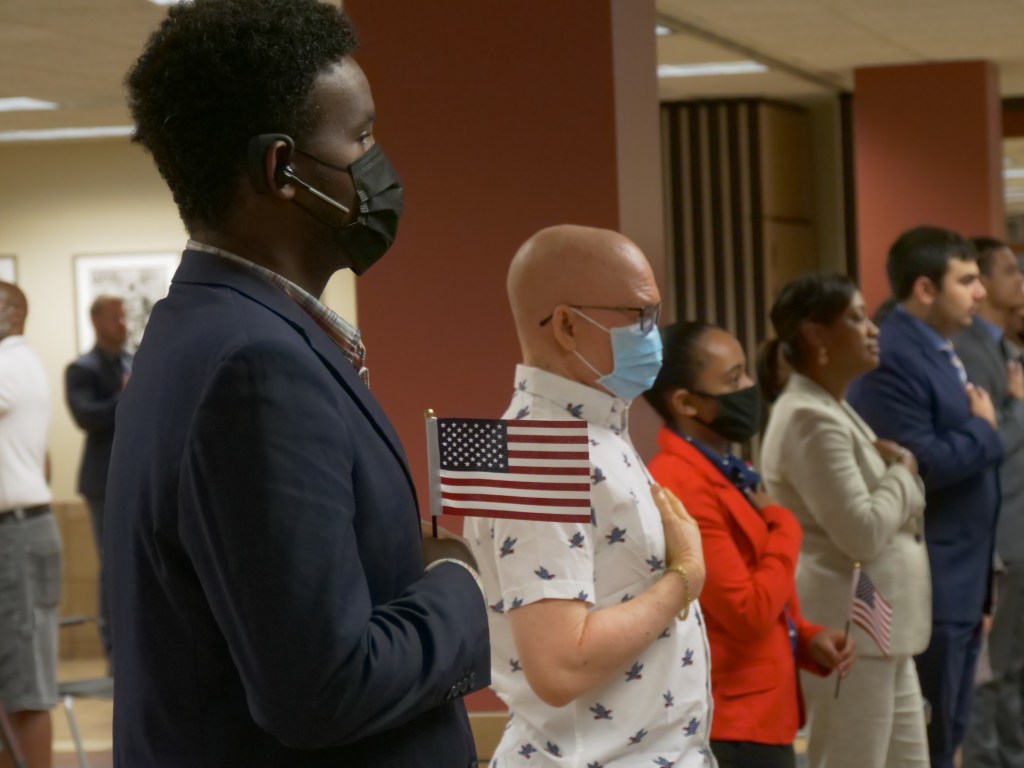
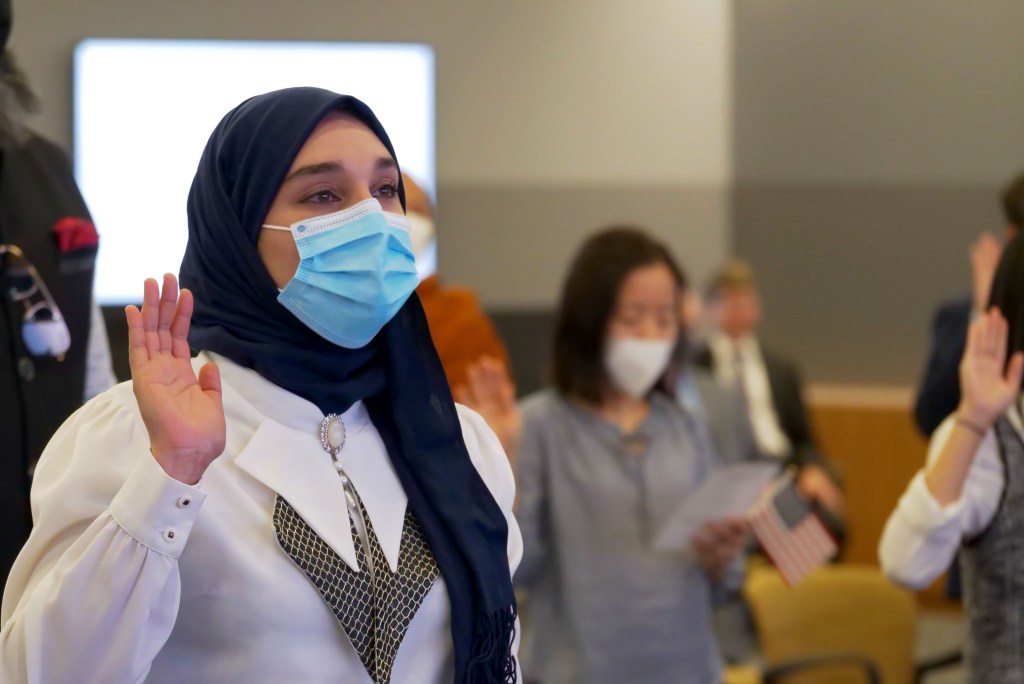
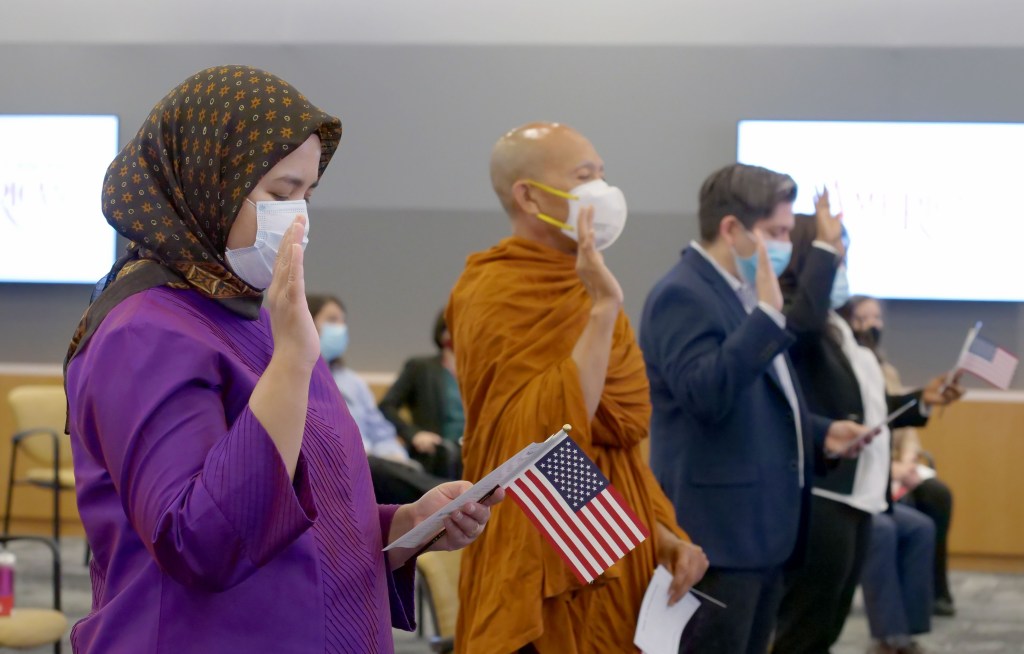
USCIS Photos | New U.S. Citizens Taking The Oath of Allegiance
Can Your U.S. Citizenship Be Revoked?
The Forbes Advisor outlines acts and circumstances that can be cause for revocation of U.S.
Excerpt: “The U.S. Supreme Court has ruled that a person born a citizen of this country cannot lose their nationality unless they voluntarily and intentionally relinquish it.
However, there are certain behaviors that can result in a loss of nationality, even if you were born in the United States. That’s because the Court ruled that actions inconsistent with remaining a citizen can be a form of voluntary relinquishment.”
Read the full text from the Forbes Advisor
Summary

Native American citizens have become increasingly concerned about the rising Muslim populations in communities. While Muslims have absolutely no legal authority to impose Sharia laws and customs on residents, activist Muslims can dramatically affect and/or change a community when the minority population approaches the societal tipping point.
The U.S. Constitution inherently prohibits any and all systems of law that are not within the scope of the Supreme Law of the Land. Only legitimate governmental entities within the definition of the Supreme Law of the Land can exact financial penalties (fines), seizure of property, dissolve contracts, nullify marriages, etc.
Knowledge is Power
John White
Rockwall, Texas

 John N. White