
“Nothing in the world is more dangerous than sincere ignorance and conscientious stupidity.”
― Martin Luther King Jr.
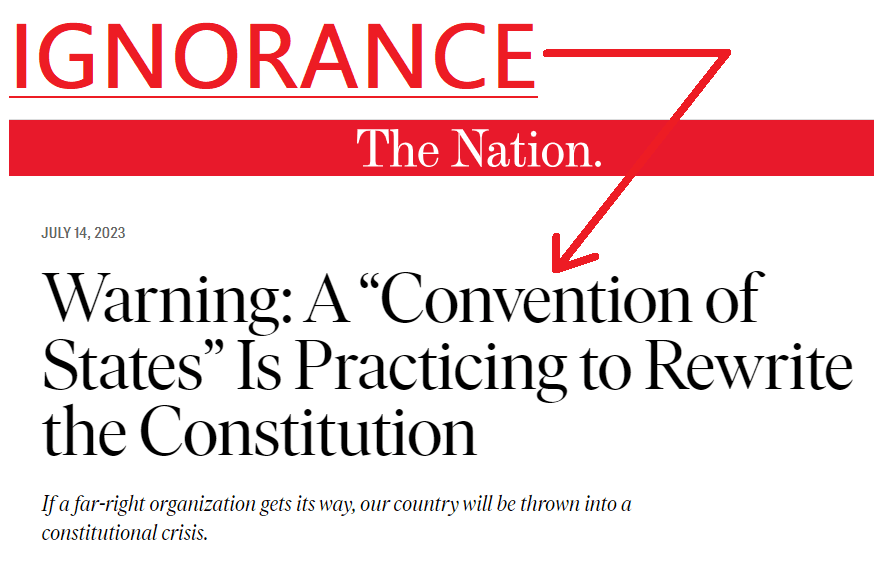
Democracy? Somebody missed civics class!
Ignorant and misleading quote from The Nation:
“If Convention of States gets its way, our country will be thrown into a constitutional crisis with no guarantee that our democracy survives.”
As per Article IV, Section 4 of the U.S. Constitution, our form of government is not a democracy but a Republican form of government.
“I do not say that democracy has been more pernicious on the whole, and in the long run, than monarchy or aristocracy. Democracy has never been and never can be so durable as aristocracy or monarchy; but while it lasts, it is more bloody than either. … Remember, democracy never lasts long. It soon wastes, exhausts, and murders itself. There never was a democracy yet that did not commit suicide. It is in vain to say that democracy is less vain, less proud, less selfish, less ambitious, or less avaricious than aristocracy or monarchy. It is not true, in fact, and nowhere appears in history. Those passions are the same in all men, under all forms of simple government, and when unchecked, produce the same effects of fraud, violence, and cruelty. When clear prospects are opened before vanity, pride, avarice, or ambition, for their easy gratification, it is hard for the most considerate philosophers and the most conscientious moralists to resist the temptation. Individuals have conquered themselves. Nations and large bodies of men, never.” — Founding Father John Adams, The Letters of John and Abigail Adams

In [a[ democracy most of the political offices are distributed by lot. The primary goal of the democratic regime is freedom or license. People will come to hold offices without having the necessary knowledge and everyone is treated as an equal in ability (equals and unequals alike. The democratic individual comes to pursue all sorts of bodily desires excessively and allows his appetitive part to rule his soul. He comes about when his bad education allows him to transition from desiring money to desiring bodily and material goods. The democratic individual has no shame and no self-discipline. — The Internet Encyclopedia of Philosophy, Plato: The Republic, Section VIII
Knowledge is power. Ignorance is a choice. — John N. White
There was only one convention of states ever to rewrite the Constitution: the present U.S. Constitution is the product of that convention of 1787. This happened because the country was a confederacy of 13 sovereign states united by a weak constitution with little power to do much of anything.
Our present U.S. Constitution has 7 articles and has been amended 27 times. One amendment, the 18th Amendment, was repealed by the 21st Amendment, so there are only 25 active amendments. The first ten amendments, known as the Bill of Rights, were ratified simultaneously. Therefore, since its inception, the Constitution has been amended only 15 times.
The wisdom of our founding fathers in constructing our U.S. Constitution provided the means to amend it through Article V.
The Congress, whenever two thirds of both Houses shall deem it necessary, shall propose Amendments to this Constitution, or, on the Application of the Legislatures of two thirds of the several States, shall call a Convention for proposing Amendments, which, in either Case, shall be valid to all Intents and Purposes, as Part of this Constitution, when ratified by the Legislatures of three fourths of the several States, or by Conventions in three fourths thereof, as the one or the other Mode of Ratification may be proposed by the Congress; Provided that no Amendment which may be made prior to the Year One thousand eight hundred and eight shall in any Manner affect the first and fourth Clauses in the Ninth Section of the first Article; and that no State, without its Consent, shall be deprived of its equal Suffrage in the Senate.
Two parties can propose a constitutional amendment: The Congress or a Convention of States. OR is the conjunction, meaning either party can propose an amendment.
Following the constitutionally prescribed Convention of States path:
- 2/3 of the state legislatures can vote for a Convention of States
- A Convention of States proposes Amendments
- The Congress can propose the ratification process to be either Conventions of States or 3/4 of the State legislatures
- 3/4 of the States are required to ratify the proposed Amendments
- Ratified amendments become the supreme law of the land, as per Article VI
In Summary

A Convention of States is not a rogue organization but a grassroots, constitutionally-prescribed process for amending the U.S. Constitution. Sign the petition to call for an ARTICLE V Convention of States.
John White
Rockwall, Texas

 John N. White